Reflective Running Gear: Staying Visible on Dark Morning & Evening Runs
Last October I was halfway through an easy Tuesday evening run when a pickup rolled through a stop sign about fifteen feet in front of me. The driver never saw me—he was looking for car headlights, not a person in a gray hoodie at dusk. Nothing bad happened, but I stood on the curb for a minute with my heart pounding, doing the math on how invisible I actually was. That run changed how I dress after sunset, permanently.
The thing is, most of us already accept strange-looking gear when it solves a real problem—I made the case for that in my post on why runners wear neck gaiters. Reflective gear is the same story. It looks like overkill until the one moment it isn't. With daylight shrinking a couple minutes a day from here through December, here's the complete visibility setup I run in now, including the pieces that replace a bulky vest.
Why Visibility Gets Worse Before You Notice
The dangerous window isn't full darkness—it's dusk and dawn, the twilight zone where drivers' eyes are adjusted to daylight but the world is already dim. Your brain compensates so smoothly when you're out running that you don't realize how bad it's gotten. Studies on driver perception consistently find that motorists overestimate how far away they can spot a pedestrian at night, sometimes by a factor of two or three. A driver who thinks they saw you at 300 feet may have actually picked you up at 120.
There's also the contrast problem. Runners love dark colors—black, navy, charcoal—and asphalt at dusk is basically the same color palette. You blend into the road surface you're running next to. Add in modern LED headlights, which are brighter for the driver but create deeper shadows everywhere else, and "I run facing traffic so I'm fine" stops being a safety plan.
The seasonal math makes it worse. In August you can squeeze a run in before sunset at 7 PM. By late October, that same 7 PM run happens in pitch dark, and the morning crowd loses their light too. If you run at fixed times around work, you will run in the dark for months. Plan for it now instead of improvising in November.
How Reflective Gear Actually Works
Quick physics, because it changes what you buy. Reflective material doesn't glow on its own—it bounces a light source directly back at that source. That means it only works when headlights (or a streetlight at the right angle) hit it, and the person it protects you from is specifically the one behind those headlights. A cyclist coming at you on an unlit path with no light? Your reflectivity does nothing. That's why the best dark-run kit mixes reflectivity for traffic with something active, like a small clip light, for everything else.
The second principle that matters is biomotion. Drivers recognize the moving joints of a human being—ankles, knees, wrists, elbows—far faster than a static reflective blob on a torso. A reflective stripe across your chest reads as "signpost" at distance; reflective elements on your moving ankles and wrists read as "person." This is the argument for spreading small reflective hits around your body instead of concentrating everything in one chest panel.
So the ideal setup: reflective material at your extremities where the motion is, plus enough coverage up top to catch headlights early, plus one active light source. That combination covers drivers, cyclists, and the guy walking his dog off-leash.
Beyond the Vest: Reflective Pieces You'll Actually Wear
The classic reflective vest works, but let's be honest about its problems: it's an extra layer that traps heat, it flaps at faster paces, and it lives in your car or closet instead of on your body. Compliance is the whole game with safety gear—the best reflective setup is the one you don't have to remember to put on.
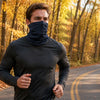
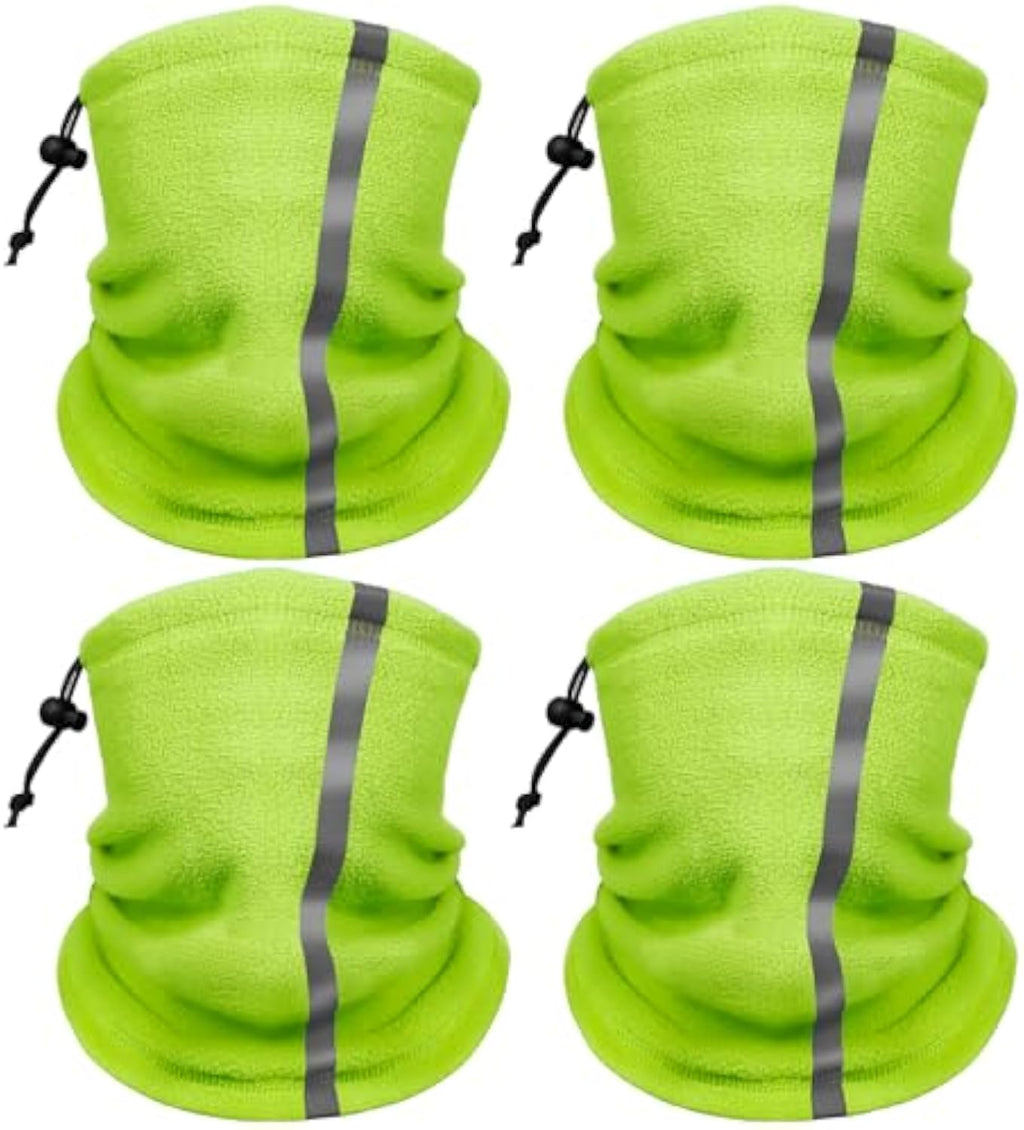
My anchor piece is the Finvizo reflective neck gaiter. It sits high on your body where headlights hit first, it has reflective striping woven in rather than printed on (so it doesn't crack off after twenty washes), and in cooler months it's doing double duty as a windproof face cover anyway. Around the neck it catches light from every direction; pulled up as a headband or face cover on cold mornings, it puts reflectivity at your highest point. A four-pack means one lives in my running bag, one in the car, one at work—there's no "I forgot it" scenario.
Below that, I lean on pieces with reflective hits already built in: running shoes almost all have heel reflectivity now, and many tights have ankle strips—use them, don't cover them with tall socks. For arms, the Finvizo arm sleeves I wear in summer aren't reflective, but on transitional evenings I'll layer a lightweight reflective band or snap-bracelet over them. Cheap, effective, and it moves with your arms, which goes back to the biomotion point.
Building a Dark-Run Kit for the Season Ahead
Here's my actual fall/winter dark-run kit, head to toe. On top: reflective gaiter around the neck, plus a headlamp or chest light when I'll be on unlit paths—the light is for me to see, and it makes me visible to non-motorized traffic that reflectivity can't help with. On the torso: whatever I'm wearing to run, with a thin reflective belt or sash if it's a dark color. On the extremities: ankle reflectivity via shoes or tights, and a wrist band on the arm that faces traffic when I run against the flow.
A few kit notes from experience. Clip lights beat nothing, but rechargeable ones beat clips—dead coin batteries are how clip lights end up in drawers. If you run with a phone in a vest or belt, some have reflective piping; check before you buy a replacement. And wash reflective gear cold and hang-dry it. High heat is what kills the glass-bead coating that does the reflecting, which is why quality Finvizo running gear holds its reflectivity season after season while cheap stuff goes dull.
For hot late-summer evenings when a gaiter sounds unbearable, the logic still holds—swap to the lightweight cooling gaiter in a bright color for daytime-into-dusk runs, and let shoes, a sash, and a clip light carry the reflective load. The goal is never one magic product; it's never being a dark shape on a dark road.
Habits That Matter as Much as Gear
Gear gets you seen; habits keep you safe. Run against traffic so you can see what's coming and bail onto the shoulder—reflectivity is backup, not armor. Assume every driver hasn't seen you until they clearly slow or move over; eye contact at intersections is the only confirmation that counts.
Route choice changes everything after dark. I ditch my usual road loops for lit park paths and quiet neighborhood streets with sidewalks, and I save the fast workouts for daylight. Oncoming headlights temporarily blind you as much as the driver, so this is not the time for technical trails or pothole slaloms. And tell someone your route or share live location—most watches and phones do this free now. Visibility is about cars, but safety is a system.
One more: on rural roads with no shoulder and no lighting, reflectivity distance math gets brutal. At 55 mph a car covers about 80 feet per second. Even if a driver spots your reflectives at 300 feet, that's under four seconds to react, steer, and pass. On roads like that, I wear the gaiter, the sash, a blinky light on my back, and I still treat every pass like they haven't seen me. Paranoia is a feature on dark roads, not a bug.
FAQ
Is reflective gear better than a headlamp for running at night?
They do different jobs. Reflective gear makes you visible to drivers—the people most likely to hurt you—by bouncing their own headlights back at them. A headlamp helps you see and makes you visible to cyclists and pedestrians without lights. The safest setup uses both: reflective hits for traffic, an active light for everything else.
Where should reflective material go on my body?
Prioritize moving joints—ankles, wrists, knees—because drivers recognize human motion (biomotion) faster than a static shape. Then add coverage high on the body, like a reflective neck gaiter or chest strap, to catch headlights early at distance. Spread it out rather than concentrating it in one patch.
Do I need reflective gear if I only run on sidewalks?
Yes. Most runner-vehicle encounters happen at intersections and driveways, not mid-block, and sidewalk runners cross both constantly. Dusk is also when drivers pulling out of parking lots and side streets have the worst visibility. A reflective gaiter or sash weighs nothing and covers exactly those moments.
How long does reflective material last?
Quality woven or bonded reflectivity lasts for years with proper care—wash cold, skip the dryer, don't iron over reflective areas. Printed or heat-transferred reflective layers on cheap gear can crack and fade within a season. If your gear looks dull under a flashlight test, it's done.
What colors are best for dusk running?
Bright fluorescent colors (neon yellow, orange, hot pink) outperform in twilight, before full dark sets in. In true darkness, color stops mattering and only reflectivity plus active lights work—that's why the best dark-run kit combines a bright base layer with reflective elements and a clip light.
If you're refining your kit for low-light miles, it's worth pairing visibility with the right sun-and-sweat pieces for the shoulder season. My guide to bounce-free neck gaiters for running covers the daytime half of the equation—fabric, fit, and breathability—so you're covered from sunrise runs straight through to the dark ones. See you out there—bright, blinking, and impossible to miss.
Related reading
- Neck Gaiter vs Running Scarf vs Balaclava
- Running Arm Sleeves: Sun Protection, Warmth, or Just Looks?
- Winter Running Face & Neck Protection: A Practical Guide

Vivian J is a Product Manager at Finvizo and an avid outdoor enthusiast. She tests gear on real trails and writes from hands-on field experience to help readers choose equipment that performs reliably outdoors.