Race Day Gear Checklist for Half & Full Marathons
I've run enough half and full marathons now to have made every race day mistake at least once: the brand-new shoes that chewed up my heels by mile 8, the gel flavor I'd never tried that staged a revolt at mile 18, the cotton t-shirt that turned into a wet sandbag by the halfway point. Race day is not the time for improvisation. After twenty-something races, I've boiled my preparation down to a checklist that lives on my phone, and I'm sharing the whole thing here.
A quick note before the list: this covers gear, not training or pacing. If your race is in warm weather, pair this with my guide to staying cool on summer runs—a lot of those tricks (pre-cooling, wet gaiters, smart hydration) apply directly to fall races that turn out unexpectedly hot, which happens more often than the forecast suggests.
The Golden Rule: Nothing New on Race Day
Every item on this checklist comes with one non-negotiable condition: you have already used it on a long training run. Race day is the worst possible day to discover that your waist belt bounces, your socks bunch, or your anti-chafe balm lasts exactly 45 minutes. Whatever makes the list below should have at least one 10-plus-mile dress rehearsal behind it.
I do a full gear rehearsal two weeks out: same shoes, same socks, same top, same belt, same breakfast, same gel timing. It feels excessive until the first time it catches a problem. Mine caught a seam on a new pair of shorts that would have ruined a goal race. Two weeks is enough time to replace whatever fails the audition.
What to Wear: Head to Toe
Shoes and socks: Your race shoes should have 50–150 miles on them—broken in, but with plenty of cushion left. Socks should be synthetic or merino blend, seamless if possible, and tested at race distance. I apply anti-chafe balm to my toes and heels regardless of how good the socks are.
Bottoms and top: Shorts or tights matched to the forecast, with pockets if you can get them. For the top, technical fabric only—no cotton, ever. If it's a sunny or warm race, this is where I'm emphatic about sun protection. A marathon puts you on exposed pavement for three to five hours, and most of us forget sunscreen on our arms entirely. I wear Finvizo UPF 50+ arm sleeves for any race above about 55°F—they block the sun, they cool via evaporation when you pour water over them at aid stations, and if the morning starts cold, they're warmer than bare arms and easy to pull down mid-race.
Head and neck: A light hat or visor for sun, and—this is the piece most runners overlook—a neck gaiter. In cool weather it keeps your neck warm at the start line, and in hot weather it becomes a cooling tool: soak it at an aid station and wear it wet. I pack a Finvizo cooling neck gaiter for basically every race now, because it weighs nothing and solves opposite problems depending on the weather. Toss it in your drop bag if you don't want to start with it.
The Carry List: What Goes in Your Belt or Pockets
Everything you carry should earn its weight. My marathon carry list, refined over many races:
Fuel: Gels or chews for the whole race, plus one spare. My rule is one gel every 40–45 minutes starting at mile 4, and I carry one more than the math says I need. Aid station gels are a gamble—brands vary, flavors vary, and your stomach has opinions. Carry your own.
Salt: Electrolyte capsules for races over two hours, especially in heat. Cramping at mile 22 is usually a sodium problem, not a fitness problem.
Phone: In a zippered pocket, not your hand. I also tuck a small amount of cash or a card in there for emergencies.
ID and a wipe: A photocopy of your ID in a zip bag, plus a single wet wipe in another bag. Trust me on the wipe.
What NOT to carry: Keys beyond your car fob, a full-size water bottle unless the race is unsupported (aid stations exist—use them), and headphones if the race discourages them. Every ounce you carry costs you energy over 26.2 miles.
Before and After: The Gear Around the Race
Throwaway layer: For cold morning starts, an old sweatshirt you can ditch at the start line (most races donate them). I've also used a cheap emergency mylar blanket and even a trash bag with armholes in a pinch. Standing shivering for 45 minutes before the gun wastes glycogen you paid good training miles for.
The finishing essential nobody talks about: a cooling towel. After I cross the line, the first thing I want is something cold on my neck while I shuffle through the finisher chute. I keep a Finvizo instant cooling towel in my checked bag—you snap it wet and it stays cold for an hour. On hot races it's the difference between enjoying the finish area and needing to lie down in the medical-adjacent shade. The Finvizo cooling gear in general has become my default race weekend kit—towel for after, gaiter during, sleeves throughout.
Post-race clothes: Dry shirt, sandals or slides (your feet will want nothing to do with real shoes), and a light jacket even in summer—you cool down fast once you stop moving.
Drop Bag Strategy and Race Morning Logistics
For full marathons with gear check, pack your bag the night before and photograph the contents—if the bag goes missing, you'll want the list. My drop bag contains the cooling towel, post-race clothes, slides, a small snack my stomach already knows, and a travel-size sunscreen for after the race (you'll be standing around in the sun for a while).
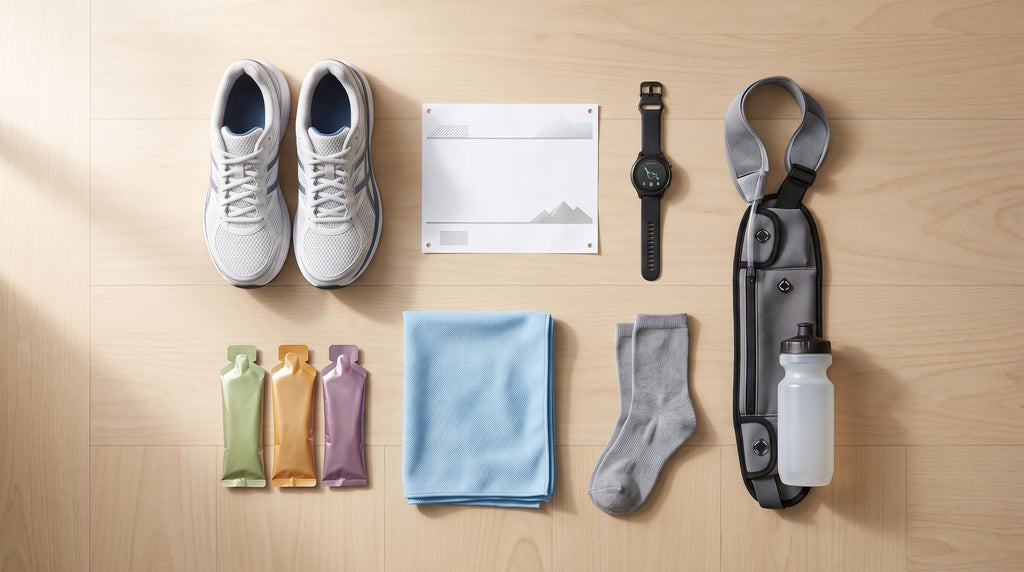
Lay everything out the night before in the classic "flat runner" photo formation: bib with pins attached, chip if it's a separate one, watch charged, shoes, socks, top, sleeves, gaiter, belt loaded with gels. Morning-of you is not a reliable decision-maker. I also set two alarms and pin my bib on before I go to sleep, because the one race I didn't, I stood in a hotel bathroom at 4:50 AM stabbing myself with safety pins.
Finally, check the race's official rules on gear: some big-city marathons restrict bag types (clear bags only), some ban vests with too many pockets, and a few restrict headphones. Five minutes on the race website saves a very bad morning at the gear check line.
FAQ
Should I wear arm sleeves for a marathon, or is sunscreen enough?
For a half, diligent sunscreen can suffice. For a full marathon, sleeves are the safer bet—you'll be out there long enough that sunscreen sweats off and reapplication mid-race basically never happens. UPF 50+ sleeves give you constant protection and add evaporative cooling when you wet them at aid stations.
What should I do with my warming layers after the race starts?
Most races collect discarded clothing near the start and early miles for donation, so a throwaway layer is the standard solution. Don't wear anything you're attached to. Alternatively, tie a light layer around your waist if temps will rise slowly—but only if you've trained that way.
How many gels do I actually need for a full marathon?
Most fueling guidelines suggest 30–60 grams of carbs per hour, which works out to roughly one gel every 40–45 minutes after the first 45 minutes of running. For a four-hour marathon that's about 5 gels; carry 6. Your exact number should be dialed in during training, not on race morning.
Is a hydration belt or vest necessary for a road marathon?
Usually no—road races have aid stations every mile or two, and carrying water for 26 miles is a big energy tax. Exceptions: trail marathons, races with sparse aid, or runners with very specific hydration needs. For most road races, trust the aid stations and carry only fuel.
What's the one item runners most often forget?
Anti-chafe protection, judging by the finish-line body language I've observed. Apply it everywhere—thighs, underarms, chest, feet, anywhere fabric touches skin. It weighs nothing, costs a few dollars, and forgetting it can define your entire last 10 miles.
If you want to go deeper on the cooling side of this kit, our guide on using a cooling towel during a marathon walks through exactly when and how to deploy one mid-race. See you at the start line—I'll be the one with the checklist.
Related reading
- Neck Gaiter vs Running Scarf vs Balaclava
- Running Arm Sleeves: Sun Protection, Warmth, or Just Looks?
- Winter Running Face & Neck Protection: A Practical Guide

Vivian J is a Product Manager at Finvizo and an avid outdoor enthusiast. She tests gear on real trails and writes from hands-on field experience to help readers choose equipment that performs reliably outdoors.