Cooling Balaclava for Motorcycle Riders: Beat the Heat Under Your Helmet
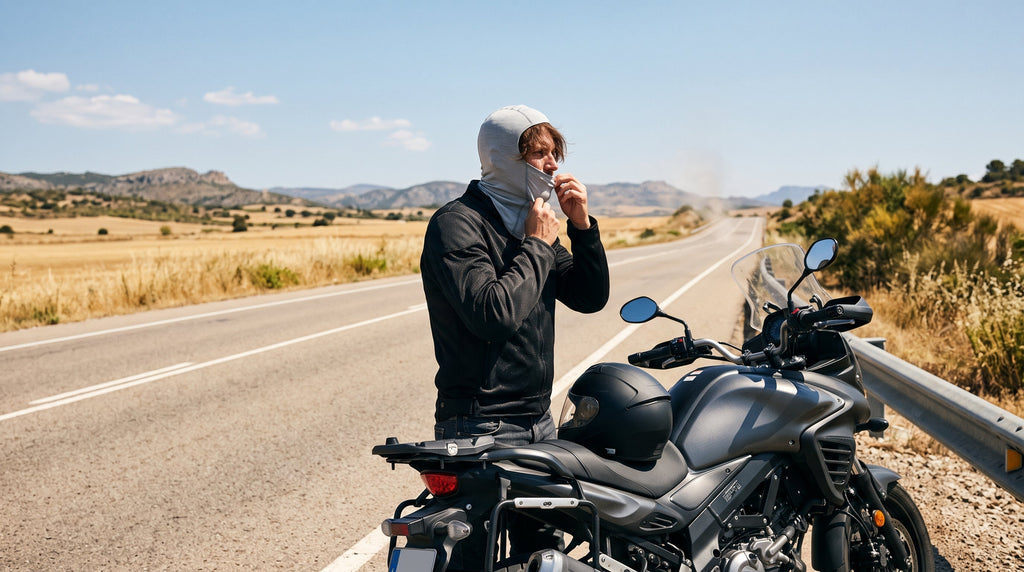
There's a moment every summer rider knows: you pull your helmet off at a gas station and the liner inside is soaked, your neck is striped red from two hours of sun at 70 mph, and your scalp feels like it's been cooking in a crock pot. I've been there — a lot. Last July I rode the stretch of US-50 across Nevada in 104°F heat, and the only thing that made it tolerable was a cooling balaclava under my helmet.
If you're new to head-and-neck sun gear, I broke down the full category in neck gaiter vs. balaclava vs. arm sleeves — worth a read if you're deciding which form factor fits your riding. This article is specifically for riders who already know they want full head coverage and need to beat the heat, not just the sun.
Why Riding in Summer Is Harder on Your Skin Than You Think
Here's something most riders underestimate: UV exposure on a motorcycle isn't just "being outside." You're getting direct overhead sun, plus reflected UV bouncing up off the pavement, plus hours of cumulative exposure with zero shade. A 4-hour ride at midday can deliver more UV to your neck and the sides of your face than a full day at the beach — because at the beach you at least reapply sunscreen and sit under an umbrella sometimes. Dust is the other half of the problem off-road — covered in neck gaiters for dust protection on ATV rides.
And sunscreen under a helmet is genuinely miserable. It mixes with sweat, runs into your eyes on the first hot climb, and turns your helmet liner into a greasy mess you'll be scrubbing later. I've ruined two liners that way before I switched to physical coverage.
The heat problem compounds it. Your helmet is essentially a foam oven. Anything you wear underneath has to move moisture away from your skin fast, or you're just trapping sweat against your scalp — which is how you end up with heat rash along the brow band by mid-August.
What a Cooling Balaclava Actually Does Under a Helmet
A good cooling balaclava solves three problems at once:
1. Physical UV block. Fabric coverage doesn't wear off, doesn't need reapplication at fuel stops, and doesn't care how much you sweat. A UPF-rated knit blocks the vast majority of UV on your scalp, ears, neck, and face — the exact zones that take the worst beating on a bike. If you want the nerdy breakdown of what UPF 50 actually means in testing, I covered it in what UPF 50 really means.
2. Evaporative cooling. The "cooling" part isn't marketing magic — it's a thin, high-wicking synthetic knit that spreads sweat across a large surface area so it evaporates fast. Moving air (even the modest airflow through your helmet vents) accelerates that evaporation, and evaporation is what actually pulls heat off your skin. On that Nevada ride, the top of my head was the coolest part of my body, no joke.
3. Helmet hygiene. The balaclava becomes the sweat layer, not your liner. At the end of a trip I toss the balaclavas in the wash and my helmet stays clean. If you ride daily through summer, that alone justifies the habit.
What to Look For: Thin Is the Whole Game
The single biggest mistake riders make is buying a winter balaclava or a thick polyester "ski mask" and trying to use it in July. Under a helmet, thickness is your enemy in three ways:
Fit. Your helmet was sized to your bare head. A thick liner changes the fit, creates pressure points at the forehead and temples, and can loosen the cheek-pad seal. You want a knit thin enough that you genuinely can't feel the difference in helmet fit.
Heat. Thick fabric insulates. In summer you want the opposite — maximum surface area, minimum loft. Look for single-layer, featherweight knits around the weight of a dress sock, not a winter hat.
Seams. Flat seams matter more than any other spec. A raised seam across the crown will find the exact spot where your helmet presses and drill into it for four hours straight. I check seams before I check anything else.
The Finvizo cooling balaclava (6-pack) is the one I landed on after cycling through four brands, mostly because it was designed thin from the start — it pulls on like a second skin, the seams are flat, and the eye opening is cut wide enough that it doesn't creep up under your peripheral vision when you tuck. It also works as a helmet liner for bicycling and skiing, so it earns its drawer space year-round.
My Setup for Long Summer Rides
This is the exact system I ran across Nevada, and I've refined it over about 6,000 summer miles:
Head: Cooling balaclava, worn with the face panel pulled down to my nose. I pull it up over my mouth only in dust or cold mornings — in pure heat I keep my mouth uncovered for airflow.
Neck: The balaclava's skirt covers the neck, but on the hottest days I add a cooling neck gaiter over it, soaked in water at every fuel stop. Wet gaiter + 70 mph airflow = legitimate evaporative air conditioning. It lasts about 45 minutes per soak, which roughly matches my fuel-stop rhythm anyway.
Arms: I ride in a mesh jacket, which flows air beautifully but lets UV straight through the weave. Underneath I wear sun sleeves from the gaiter-and-sleeve set — they're cooler than any base layer shirt I've tried, and I can peel them off at lunch without stripping the jacket.
Water discipline: Every stop: soak the gaiter, drink a full bottle, check the back of my neck in the mirror. Sunburn on the neck is cumulative — you don't feel it until you're crispy.
Common Mistakes I See Riders Make
Cotton anything. Cotton holds sweat against your skin and stops cooling the moment it's saturated. Under a helmet it becomes a wet wool blanket. Synthetic wicking knit or nothing.
Riding with the face panel up in traffic. Stop-and-go heat plus exhaust fumes plus sun directly on your face is the worst combination. Either commit to the coverage or drop the panel fully to your chin — the half-up position just bunches under your chin strap.
One balaclava for a whole trip. A saturated balaclava stops cooling and starts smelling by day two. This is honestly why I buy the 6-pack — one per riding day, wash them all when I get home. At a multi-day rally you'll see me rinse one in a motel sink and rotate.
Ignoring the ears. Your ears get blasted by reflected UV and wind for hours. A proper balaclava covers them completely; a lot of cheap ones cut the ear zone too small and they slide out.
FAQ
Does a cooling balaclava actually keep you cooler, or is it a gimmick?
It works through evaporative cooling: the fabric wicks sweat into a thin layer across a large surface, and airflow evaporates it, which removes heat. It's the same physics as sweating, just more efficient. It won't refrigerate you in dead-stopped traffic, but at any speed above about 30 mph the effect is real and noticeable.
Will a balaclava make my helmet too tight?
Only if it's thick. A summer-weight cooling balaclava is thin enough that most riders feel zero fit change. If your helmet fit is already snug, that's exactly why you want the thinnest flat-seam knit you can find — never a winter-weight liner.
Can I wear a balaclava in states with anti-mask laws?
Anti-mask laws generally target concealing identity in public spaces, and enforcement against motorcyclists wearing helmet liners is essentially nonexistent — you're wearing it under a helmet, and your face is covered by the visor anyway. That said, laws vary by state, so check your local rules if you ride with the face panel up off the bike (at fuel stops, for instance, it's courteous to pull it down).
How do I wash a cooling balaclava without ruining it?
Cold water, gentle cycle or hand wash, mild detergent, and absolutely no fabric softener — softener coats the fibers and kills the wicking. Hang dry; it takes about an hour. I go deeper on care in my guide to washing UPF clothing.
Balaclava vs. neck gaiter for riding — which one?
Balaclava if you want scalp, ear, and helmet-liner protection. Gaiter if your helmet already treats your head fine and you just need neck/face coverage. For summer highway riding I run both, as described above — they solve different halves of the problem.
The Bottom Line
Summer riding doesn't have to mean choosing between roasting inside your gear and burning outside it. A thin cooling balaclava under your helmet handles sun, sweat, and liner hygiene in one move — and it costs less than a tank of gas. Pair it with a wet gaiter and sun sleeves and you've got a full system that carries you through the worst miles of the year.
And if your riding trip turns into a camping trip — mine usually do — my camping gear checklist over on the Camping blog covers everything else I throw in the panniers.
Related reading
- What Is a Balaclava? Uses, Fit & How to Wear
- Balaclava vs Ski Mask vs Neck Gaiter: Winter Face Cover Guide
- Best Ski Face Masks 2026: Warmth, Anti-Fog & Helmet Fit Guide

Vivian J is a Product Manager at Finvizo and an avid outdoor enthusiast. She tests gear on real trails and writes from hands-on field experience to help readers choose equipment that performs reliably outdoors.