Sun Protection for Golfers: Sleeves, Gaiters & What Actually Works
Last August I played 18 holes at a course just outside Phoenix. The thermometer read 103°F by the turn, and I watched three separate players bail after the ninth hole with headaches and flushed skin. I finished the round—slowly, hydrated, and with zero sunburn—because I had planned my protection like I plan my club selection. If you golf in summer, sun protection is not optional. It is course management.
Golfers face a unique UV challenge. You are outside for four to five hours with almost no shade. Water hazards and sand traps reflect sunlight upward, hitting skin angles that direct overhead sun misses. And the repetitive motion of a golf swing means any gear you wear has to stay put, breathe well, and never distract you at address. I have tested just about every combination of gaiters, sleeves, and hats on the course. Here is what actually holds up over 18 holes.
If you are still deciding between coverage types, our Neck Gaiter vs Balaclava vs Arm Sleeves comparison breaks down the pros and cons of each piece so you can build the right kit for your climate.
Why Golfers Get Burned Worse Than Most Athletes
Most people think of sun exposure in terms of direct overhead rays. Golfers get that, plus reflected UV from fairway grass, water, and sand. The Skin Cancer Foundation estimates that water reflects up to 80% of UV rays, while sand and concrete reflect 15–25%. A golfer standing near a lake or bunker is getting hit from above and below simultaneously.
Then there is duration. A round of golf is not a 45-minute run. It is a half-day commitment. Even SPF 50 sunscreen breaks down after two hours of sweat and movement. Reapplication is theoretically the answer, but nobody wants to pause at the turn, dig a bottle out of the bag, and grease up their forearms before eating a hot dog. Physical barriers—sleeves, gaiters, wide-brim hats—do not degrade. They work for the full five hours without a second thought.
The other factor is altitude. Mountain courses in Colorado, Utah, or Arizona sit at 4,000–7,000 feet, where UV intensity increases roughly 10–12% per 1,000 feet of elevation. A 90°F day at sea level is manageable. A 90°F day at 6,000 feet is a different animal entirely.
Arm Sleeves: The Golfer's Secret Weapon
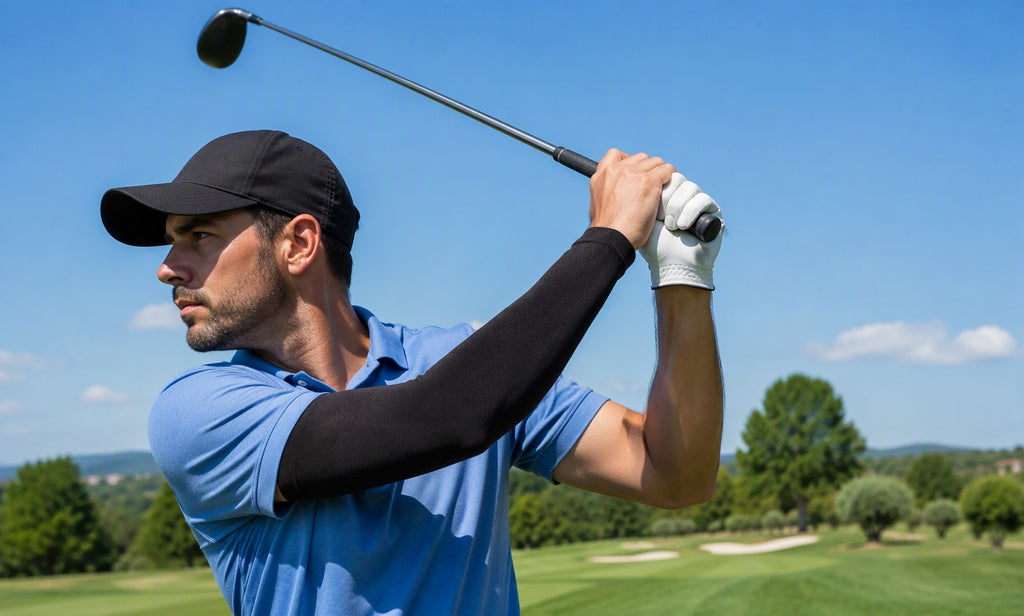
If I could only pick one piece of sun-protection gear for golf, it would be arm sleeves. Here is why.
They cover the entire forearm and bicep—the area most exposed during a golf swing—without restricting your range of motion. A good sleeve stays in place from the first drive to the final putt. Our Finvizo UPF 50+ arm sleeves use a silicone gripper band at the top that prevents slippage without squeezing. I have never had to adjust them mid-swing.
The cooling effect is noticeable, especially on dry courses in Arizona or California. The moisture-wicking fabric pulls sweat to the surface where it evaporates, dropping skin temperature by a few degrees. On humid courses in Florida or South Carolina, the cooling is subtler, but the UV block is absolute. Either way, your arms are protected for the full round.
Color choice matters on the course. I prefer white or light gray sleeves for summer rounds. They reflect more radiant heat than black, and under a polo they look subtle and professional. Most courses do not have a dress-code opinion on sleeves, but if yours does, neutral colors blend in.
Neck Gaiters: Protecting the Collar Line and Ears
The neck and ears are two of the most common spots for skin cancer in men over 50. They are also the spots golfers forget to sunscreen. Your polo collar might cover an inch of skin, but the lower neck, back of the neck, and ears are fully exposed for five hours straight.
A lightweight neck gaiter solves this without making you look like you are prepping for a ski trip. I wear ours pulled up to cover the lower face and ears on especially bright days, or folded down as a loose neck scarf when I want more airflow. The Finvizo 4-Pack Neck Gaiter is thin enough that you barely notice it, and the stretch fabric means it does not bunch or sag as you rotate through your swing.
One trick I picked up from a PGA instructor: wet the gaiter slightly at the turn. The evaporative cooling effect on the back of your neck is immediate and dramatic. It is like having a personal cooling towel that stays in place.
For golfers who want full face and neck coverage, our cooling balaclava is a step up. I do not wear it at every course—some older clubs still side-eye full face coverage—but on desert tracks where the sun is relentless, it is the difference between finishing strong and fading on the back nine.
Headwear: The Missing Piece Most Golfers Skip
I will keep this brief because you probably already own a golf hat. But the details matter.
A standard baseball cap protects the forehead and front of the scalp. It does not protect the ears, the back of the neck, or the temples. If you are serious about sun protection, a wide-brim hat or a cap with a neck flap is the move. I switch to a wide-brim straw hat for summer scrambles. It looks a little more safari than Tour, but my dermatologist approves.
Whatever hat you choose, pair it with a gaiter. The gap between cap brim and collar is a sunburn highway.
Sunscreen Still Has a Role—But It Is Not Enough Alone
I am not anti-sunscreen. I apply SPF 50 to my face, hands, and any skin not covered by a sleeve or gaiter. But sunscreen is a supplement, not a primary defense, for a sport this long and this exposed.
The problem with relying on sunscreen alone for golf is reapplication timing. Dermatologists recommend reapplying every two hours. On a four-and-a-half-hour round, that means at least two applications, ideally three. Most golfers I know apply once in the parking lot and call it good. The sleeves and gaiter do not require reapplication. They do not wash off with sweat. They do not sting your eyes when you wipe your forehead.
Think of it like layering: physical barriers as your base, sunscreen as your backup.
What I Wear for Different Course Conditions
Over time I have developed a pretty simple system based on temperature and UV index.
Hot, dry, high UV (Arizona, Nevada, Utah): Full kit. White arm sleeves, light gray gaiter pulled up to the ears, wide-brim hat, SPF 50 on face and hands. I also pack electrolyte tablets. The dry heat dehydrates you faster than you feel.
Hot, humid, high UV (Florida, Texas, South Carolina): Arm sleeves and loose gaiter around the neck. Humidity reduces evaporative cooling, so I skip the full face coverage and rely on maximum airflow. Light colors are essential.
Moderate, partly cloudy (Pacific Northwest, Midwest): Do not get complacent. Clouds block visible light, not UV. I still wear sleeves and a gaiter, but I might go with darker colors since heat is less of a factor.
If you are building out your summer kit, our Neck Gaiter + Arm Sleeves Set gives you matched coverage at a better price than buying separately.
Comfort Tips for Wearing Sun Gear During a Round
The best sun protection in the world does not help if you are fidgeting with it on every hole. Here is how I make gear invisible during play.
Put sleeves on before you leave the house, not in the parking lot. They need a few minutes to settle into position. Check the gripper band placement—too high and it pinches the armpit; too low and the sleeve creeps.
With gaiters, avoid thick fleece or winter-weight fabrics in summer. A thin, single-layer gaiter is all you need. Fold it to the height you want and let the stretch fabric do the rest.
Bring a backup. I keep a second pair of sleeves and a spare gaiter in my bag. If the first set gets soaked with sweat, switching at the turn feels like a reset button.
And when the season winds down, start thinking about how your gear transitions into fall. Our Camping Gear Preparation Before Purchase guide covers the same decision-making framework I use for golf and camping gear—buy once, buy right.
Frequently Asked Questions
Do pro golfers wear sun-protection sleeves?
Yes, increasingly so. Players on the PGA Tour, LPGA Tour, and Korn Ferry Tour have been spotted wearing arm sleeves during practice rounds and tournament play in hot climates. Some wear them for UV protection; others for the subtle compression benefit.
Will arm sleeves affect my golf swing?
A properly fitted sleeve should not affect your swing at all. Look for a thin, stretchy fabric with flatlock seams. Avoid thick or poorly fitted sleeves that bunch at the elbow. Test your full range of motion before teeing off.
Can I wear a neck gaiter under a golf polo collar?
Absolutely. A thin gaiter tucks neatly under a polo collar without adding bulk. Many golfers fold it into a single layer and let it sit just above the collar line. It is invisible from the front and provides full back-of-neck protection.
Is a wide-brim hat better than a cap for golf sun protection?
For pure protection, yes. A wide-brim hat covers the ears, temples, and back of the neck. A standard cap does not. The trade-off is style and wind stability—wide brims can flap in a strong breeze. Some golfers compromise with a cap plus a neck gaiter.
How do I clean sun-protection gear without ruining the UPF rating?
Wash in cold water with a mild detergent, avoid fabric softeners, and hang dry. Heat from a dryer can degrade the elastic fibers and any chemical UV treatments. Most quality sleeves and gaiters hold their UPF rating through 50–70 washes with proper care.
Related reading
- Volleyball Arm Sleeves: Why Players Wear Them & Top Picks
- Do Arm Sleeves Actually Keep You Cool? Here's the Science
- Cooling Towel vs Regular Wet Towel: Does It Actually Work Better?

Vivian J is a Product Manager at Finvizo and an avid outdoor enthusiast. She tests gear on real trails and writes from hands-on field experience to help readers choose equipment that performs reliably outdoors.