Neck Gaiter vs Bandana: Which Covers You Better?
Neck Gaiter vs Bandana: Which Covers You Better?
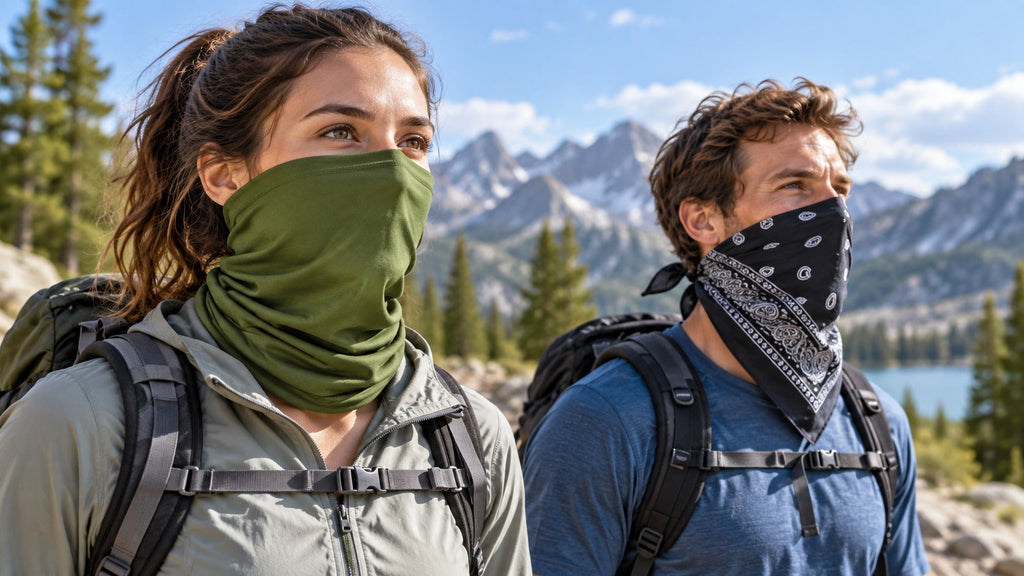
Bandana face mask or bandana face mask alternative? A neck gaiter generally gives you more continuous neck-and-lower-face coverage, while a bandana offers simpler, adjustable tie-on wear. Choose the gaiter for active sun exposure and fast repositioning; choose the bandana for casual use, airflow, and a familiar cotton feel.
If you want ready-to-wear coverage, the Finvizo UPF 50+ Cooling Neck Gaiter 4/8 Pack is the practical starting point. Its tube shape removes knots, and the listing specifies lightweight moisture-wicking polyester, approximately 17.8 × 9.6 inches, and one-size-fits-most stretch.
What should you compare first?
Start with exposed area, stability, fabric, and your activity. A triangular bandana can cover your nose, mouth, and upper neck, but its lower point leaves the sides of your neck more exposed. A neck tube wraps 360 degrees and can extend from your collar to your cheekbones. That extra fabric matters during fishing, cycling, hiking, or yard work.
Fit changes real coverage. A loose face covering can slide below your nose; a small bandana can pull tightly at the knot. Test head movement before leaving home. Turn left and right, look down, and speak. If gaps open or fabric drops, retie it or choose a closer-fitting option.

Bandana vs gaiter: quick comparison
| Factor | Neck gaiter | Bandana |
|---|---|---|
| Coverage | Continuous lower-face and neck tube | Triangular front; variable side coverage |
| Adjustment | Pull up or down in seconds | Retie the rear knot |
| Activity fit | Stays streamlined for movement | Loose corners may flap in wind |
| Fabric choice | Usually stretch synthetic | Often woven cotton |
| Best value | Multi-wear versatility | Low-cost everyday simplicity |
A bandana wins when you value a loose feel, easy washing, and many colors. It can become a head wrap, sweat cloth, or small gear marker. However, knot pressure and shifting can become distracting during long sessions. It also does not automatically provide a tested ultraviolet rating. Measure yours before a trip, because square dimensions determine how much fabric reaches beneath your chin and around your neck.
A gaiter wins for rapid changes. You can lower it to your neck in shade and raise it when sun, dust, or wind increases. The continuous tube also layers neatly under a cap or collar. Neither option replaces sunscreen, shade, eyewear, or other protective clothing on exposed skin.
Product spotlight: a four-color coverage kit

The Finvizo Cooling Neck Gaiter comes in four-pack and eight-pack color sets. The verified listing states UPF 50+ fabric coverage and machine-washable care. Its approximately 17.8 × 9.6-inch stretch-polyester tube can be worn as a gaiter, lower-face cover, head wrap, headband, or bandana-style wrap.
The four-pack is useful when you rotate clean gear between outings or share colors with family members. Moisture-wicking fabric helps move perspiration, although cooling depends on humidity, airflow, and activity. Replace a stretched, thinned, or damaged gaiter because fabric condition and fit affect coverage.
How should you use either covering in sun?
Pull the material high enough to cover your lower face without blocking vision, and overlap the bottom with your shirt collar. The U.S. Environmental Protection Agency recommends protective clothing, shade, and sunscreen; it also notes that water, snow, and sand reflect UV rays. Reapply broad-spectrum sunscreen to uncovered skin after swimming or sweating.
The Centers for Disease Control and Prevention also treats clothing, shade, hats, sunglasses, and sunscreen as a combined sun-safety strategy. No fabric should be treated as your only safeguard. Check the UV Index, inspect the covering for wear, and carry a dry spare when you expect heavy perspiration.

Who should buy which?
Choose a neck gaiter if you move frequently, want fuller neck coverage, or need one item that converts into several styles. Choose a bandana if you prefer woven cotton, want adjustable tension, or mostly need short-duration casual coverage. For cycling, fishing, and long sunny hikes, the gaiter is usually the more secure all-around choice.
Coverage Math and Cost per Wear
A standard bandana is a 22-inch square of woven cotton: great as a sweat rag or pot holder, but it leaves gaps at the sides of the neck and needs retying every time you bend over. A tubular gaiter is a continuous loop — typically 19 to 20 inches long — so coverage moves with you instead of against you. For cycling, fishing, and long sunny hikes, that difference is the whole game.
On cost, our Finvizo Breathable Neck Gaiter 4-pack runs $14.98 — under $3.75 apiece — about the price of two cotton bandanas, with UPF-rated sun fabric and no knots. If you want one item that converts into a face cover, headband, beanie, and wristband, the tube earns its pocket space.
Care and Rotation
Whichever you choose, wash it after every sweaty day: salt and sunscreen degrade elastic fibers and cotton alike. Cold water, mild detergent, no dryer. Keep a rotation so a damp one never goes back on your face.
For dusty trails and windy ridges, the sealed tube wins again — a bandana's tied corners leak air at the cheeks, while a gaiter's continuous knit filters more consistently.
Frequently asked questions
Is a neck gaiter better than a bandana?
It is better for continuous neck coverage and fast repositioning. A bandana may feel airier and lets you adjust knot tension, so comfort still depends on fabric, fit, weather, and activity.
Can you wear a gaiter as a bandana?
Yes. A stretch neck tube can be folded or twisted into a head wrap or headband. Follow the product instructions and avoid folds that reduce your field of view.
Does a face covering replace sunscreen?
No. Apply sunscreen to exposed skin and combine your covering with shade, a brimmed hat, sunglasses, and suitable clothing. Coverage changes when material stretches, shifts, becomes wet, or wears thin.
How often should you wash a neck tube?
Wash it after a sweaty or dusty outing and before sharing. Follow the care label, use mild detergent, and let it dry completely before storage.
Ready for simple, full-wrap versatility? Explore the Finvizo neck gaiter collection, or view the Cooling Neck Gaiter 4/8 Pack for verified sizes, colors, and current availability.
Related reading
- 100 Blackout Sleep Mask: Complete Darkness for Better Sleep
- Winter Face Mask for Cold Weather: Warmth & Coverage Guide
- What Is a Balaclava? Uses, Fit & How to Wear

Written by Vivian J
Product Manager at Finvizo and an avid camper who tests gear on real trails. She writes from hands-on field experience to help you pick equipment that actually holds up outdoors.