Beach Cart vs Beach Wagon: Which Rolls Better on Sand?
Beach Cart vs Beach Wagon: Which Rolls Better on Sand?
Every summer I watch the same scene at the Outer Banks: a family dragging a narrow-wheeled wagon through soft sand like a plow, dad sweating, cooler threatening to tip. The problem usually isn't the wagon — it's that "beach cart" and "beach wagon" get sold as interchangeable when they're actually different tools. I cover wagon selection broadly in my wagon buying guide for campers, but the beach-versus-cart question deserves its own answer. Here's how the two actually compare on sand.
Beach Cart vs Beach Wagon: What's the Actual Difference?
The names get used loosely, but the designs are distinct:
- Beach cart: A two-wheeled upright frame — think a dolly with a cargo bag or basket. You tilt it back and pull it behind you. The wheels are usually huge (10-13 inches) and often balloon-style, built specifically for sand. Capacity typically runs 75-150 liters.
- Beach wagon: A four-wheeled pull-along box with a handle, usually foldable. Capacity is bigger — commonly 100-200 liters — and it works on grass, gravel, and pavement as well as sand. Wheel quality varies enormously by price.
In short: carts are sand specialists. Wagons are generalists that can be very good on sand if the wheels are right.
What Actually Matters on Soft Sand
Forget the marketing names — three measurements decide whether anything rolls on sand:
- Wheel width. This is 80% of the battle. Narrow wheels (under 2.5 inches) knife into soft sand and plow. Wheels 3.5 inches and wider float on top. Balloon wheels take this to the extreme at 6+ inches wide.
- Wheel diameter. Bigger diameter (8 inches and up) rolls over ruts and shell beds instead of catching in them. Small casters are the first thing to fail at the beach.
- Load balance. A two-wheel cart carries part of the load on your arm — that's why they feel light even when full. A four-wheel wagon carries everything on its wheels, which is easier on your body but demands more from the wheels themselves.
Side-by-Side: Cart vs Wagon on the Beach
| Beach Cart (2-wheel) | Beach Wagon (4-wheel) | |
|---|---|---|
| Deep soft sand | Excellent with balloon wheels | Good only with wide wheels (3.5"+) |
| Packed sand / wet sand | Excellent | Excellent |
| Grass, gravel, parking lots | Awkward — tippy and slow | Excellent |
| Capacity | 75-150 liters | 100-200 liters |
| Arm effort | Higher — you carry part of the load | Lower — wheels carry everything |
| Storage at home | Bulky, stands upright | Folds flat in seconds |
The verdict: dedicated balloon-wheel carts win on truly deep, loose sand — think Florida Gulf beaches or the soft stuff above the tide line. Everywhere else, a well-wheeled wagon is the better tool, and it's not close.
When One Wagon Handles Both Campground and Beach
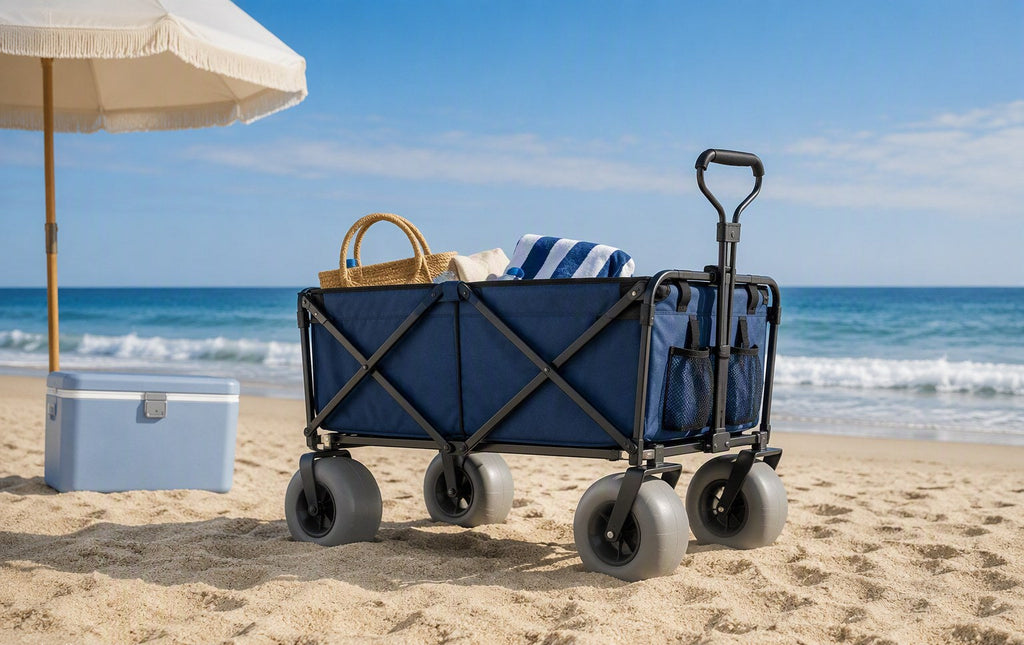
Most families I talk to don't want a single-purpose cart that lives in the garage 10 months a year. That's exactly why we spec'd the Finvizo folding wagon the way we did: 3.6-inch wide wheels that float on packed and moderately soft sand, a 600 lbs frame rating that laughs at a loaded cooler, and 160 liters of cargo space with a drop-down tailgate for beach chairs and umbrellas. It folds flat and fits in a trunk next to the beach bag.
If your beach is the deep-sugar-sand kind, my soft sand beach wagon guide breaks down which wheel setups survive it — that's a specialist purchase and worth reading before spending. For everyone else, one good wagon covers Memorial Day through Labor Day. Browse the current lineup in the Finvizo camping cart collection.
Keeping Salt and Sand from Killing Your Wheels
Whatever you buy, beach gear dies from neglect, not use. Sand grinds into wheel bearings and salt air corrodes frame hardware. After every beach day, hose the whole thing down with fresh water, spin each wheel while rinsing to flush the bearings, and let it dry fully open before folding. I walk through the full routine in my wagon cleaning guide — five minutes of rinsing is the difference between three seasons and ten.
And if the beach day turns into an overnight, a pop up tent for quick beach shade or camping pitches in about two minutes — no poles to thread with sandy hands.
Frequently Asked Questions
What is the difference between a beach cart and a beach wagon?
A beach cart is a two-wheeled tilt-and-pull frame with oversized wheels, built as a sand specialist. A beach wagon is a four-wheeled pull-along cargo box, usually foldable, that works on sand, grass, gravel, and pavement. Carts roll easiest on deep soft sand; wagons carry more and handle every other surface better.
Can you use a regular wagon on the beach?
Yes, if the wheels are at least 3.5 inches wide and 8 inches in diameter. Narrow hard-plastic wheels dig into soft sand and make the wagon nearly impossible to pull when loaded. On packed wet sand near the water, almost any wagon rolls fine.
What wheels are best for sand?
Balloon wheels (6+ inches wide) are best for deep, loose sand. For mixed use — beach plus campground plus parking lots — wide all-terrain wheels around 3.5-4 inches with real bearings are the practical sweet spot. Avoid narrow plastic casters entirely for beach use.
Is a beach wagon worth it?
If you go to the beach more than twice a summer with kids, coolers, or chairs, absolutely. A loaded beach trip typically means 50-100 lbs of gear, and a wagon turns three trips from the car into one. Choose a foldable model so it earns its storage space year-round.
How do you clean a wagon after the beach?
Rinse the entire wagon with fresh water, spinning each wheel to flush sand from the bearings. Wipe down the frame hardware to remove salt, shake out the fabric, and let everything dry fully open before folding. Never store a damp wagon folded — that's how you get mildew and corroded joints.
Related reading
- Best Collapsible Wagons for Camping and Beach Trips 2026
- How to Clean a Camping Wagon After the Beach: Full Guide
- Wagon vs Wheelbarrow: Which Hauls Camping Gear Better?

Vivian J is a Product Manager at Finvizo and an avid outdoor enthusiast. She tests gear on real trails and writes from hands-on field experience to help readers choose equipment that performs reliably outdoors.