Full Face Ski Mask for Skiing: Fit, Coverage & Helmet Guide
The ideal full face ski mask fits snugly under your helmet with two fingers of clearance, seals fully around goggles, and includes a breathable panel to...
Finvizo Winter Balaclava Ski Mask | Windproof Fleece Warm Face Cover Hood for Skiing Snowboarding & Cycling — 360-Degree Protection: Complete coverage for head, face, neck and ears
View ProductWhat "Full Face" Actually Needs to Cover
A full face ski mask earns the name only if it closes five zones: crown, ears, nose and cheeks, mouth, and the neck-to-collar seam. The zone most masks fail is the last one — that stripe of exposed skin between the mask's lower edge and your jacket collar, which funnels wind straight up to your chin at speed. A proper full-face cut measures around 13.2 by 21.3 inches laid flat, enough to wrap the head and still tuck 3-4 inches below the collarbone.
Coverage also has to survive movement. Turn your head fully left and right before you buy: if the eye opening drifts or the neck skirt pulls out of your collar, the mask will do the same thing at 30 mph on a groomer — except then your hands are busy.
The Fit System: Measure Once, Check Twice
Two fit styles dominate, and the choice is about how you ski:
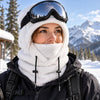
- Fixed-stretch cut — pulls on in seconds, lowest bulk, nothing to adjust. The Finvizo winter balaclava ($16.99, nine colors) is the template: soft windproof fleece with a stretchy cut that sits flat under a helmet.
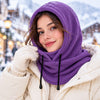
- Drawstring-adjustable — a cord around the face opening lets you tighten the seal in wind or loosen it on a warm spring day. The Finvizo fleece balaclava ($17.99, seven colors) adds that adjustability plus extended neck coverage for about a dollar more.
Whichever style you pick, run the two-finger check: with the mask on and your helmet buckled, slide two fingers between the mask and your brow. They should fit snugly — no third finger, no struggle. Looser and wind gets in; tighter and you get pressure headaches by lunch. That one check eliminates most "my mask is uncomfortable" complaints, because the problem was never the mask.
Helmet and Goggles: Making the Stack Work
The mask-helmet-goggle stack fails at the seams. Bulk under the helmet shell changes the helmet's fit — dangerous, since a helmet riding even half an inch high protects measurably less. Choose a mask that's thin where the helmet sits (crown and temples) and warm where the wind hits (face and neck); 200-300gsm fleece hits that balance without turning your helmet into a vise. For the full under-helmet playbook, our guide on wearing a balaclava under a helmet walks through five fitting steps.
Goggles need the opposite: overlap, not gap. The mask's upper edge should tuck slightly under the goggle frame so no skin shows — that thin stripe of exposed forehead or cheekbone is where frostnip starts on storm days. Pull the goggle strap over the mask, not under it, so adjustments don't drag the mask out of place.
Breathability and Fog Control
Every full face ski mask trades warmth against breathability at the mouth. A solid fleece panel over the mouth is warmest but pumps moist air upward into your goggles with every breath. The fix is a breathing panel — mesh or perforated fabric over the mouth and nose that vents moisture forward instead of up. Moisture-wicking fleece handles the rest, moving sweat off your skin before it can chill you on the lift.
If fogging is already your recurring problem, the mask is usually half the cause and goggle technique is the other half — we cover both in how to stop glasses and goggles fogging with a face mask .
Warmth Math: What the Lift Actually Does to Your Face
Windchill is the real opponent, and the numbers are rude: at 40 mph — a fast groomer or a chairlift swinging through a headwind — a 40°F day feels like about 25°F on exposed skin, and a 20°F day drops to single digits. At those numbers, uncovered skin can develop frostnip in under 30 minutes. A windproof fleece layer over the full face cuts that exposure to nearly zero, which is why a $17 Finvizo ski mask outperforms a $60 neck tube plus hat combination that leaves the cheeks open.
One last practical note from the laundry room: machine-washable fleece that holds its shape matters more than any spec sheet admits, because a mask you actually wash stays against your skin all season. Both Finvizo balaclavas above are machine washable without losing their cut.
Heading out for a winter run instead of the slopes? The face-protection logic shifts a little — lighter fabric, more venting — and our winter running face and neck protection guide covers that setup.
Which Full Face Ski Mask Is Right for You?
- Finvizo Winter Balaclava Ski Mask — Skiers wanting a simple, warm, low-bulk mask — Fixed-stretch fleece with full coverage and breathability, fits snug under helmet with no pressure points
- Finvizo Winter Fleece Balaclava — Those needing adjustable fit and extra neck warmth — Drawstring adjustable face opening, thicker fleece for colder days, extended neck skirt for better seal
- Neck gaiters or lighter masks — Warm-weather or high-output skiing — More breathable, less coverage, but less wind protection
Numeric Facts About Full Face Ski Masks
- Full face mask flat size — Approx. 13.2 × 21.3 in — https://finvizo-official.com/blogs/winter/best-full-face-ski-mask — 2026-09-16
- Mask thickness for helmet fit — 200-300 gsm fleece — https://finvizo-official.com/blogs/winter/best-full-face-ski-mask — 2026-09-16
- Ideal helmet clearance — Two fingers (~0.75 inch) — https://finvizo-official.com/blogs/winter/best-full-face-ski-mask — 2026-09-16
- Neck skirt length — 3-4 inches below collar — https://finvizo-official.com/blogs/winter/best-full-face-ski-mask — 2026-09-16
Main answer
Choosing the right full face ski mask is crucial for comfort, warmth, and safety on the slopes. Many skiers default to choosing based on fabric or price, only to spend their first run adjusting their mask. After years of testing, I can say the fit system matters most — it governs how your mask works under a helmet, how well it blocks wind, and how much it fogs your goggles. See What Is A Balaclava for related details. See Winter Sports Ski Face Masks for related details.

Our Pick: Finvizo Winter Balaclava Ski Mask | Windproof Fleece Warm Face Cover Hood for Skiing Snowboarding & Cycling — 360-Degree Protection: Complete coverage for head, face, neck and ears
- 360-Degree Protection — Complete coverage for head, face, neck and ears shields you from wind and snow while skiing, snowboarding, cycling and hiking.
- Skin-Friendly Warm Fleece — Soft moisture-wicking fleece balances windproofing and breathability; the smooth inner lining resists pilling for long-lasting wear.
- Stylish & Easy to Wear — Nine modern colors, a soft stretchy cut that pulls on in seconds, and a low-bulk profile that fits seamlessly under helmets without fogging goggles.
- Outdoor Essential — Wear- and tear-resistant and machine washable without losing shape - ready for running, hunting and daily commuting all winter.
FAQ
What is the difference between a full face ski mask and a balaclava?
They are essentially the same garment. A full face ski mask is a balaclava designed specifically for skiing, optimized for low bulk under helmets, goggle compatibility, and having a breathing panel.
How should a full face ski mask fit under a helmet?
It should fit snugly with about two fingers’ width of space between the mask and your brow when the helmet is buckled. The mask should not add bulk at the crown or temples; if it does, it may compromise helmet fit and safety.
Do full face ski masks make goggles fog up?
They can if moist breath escapes upward. Masks with breathing panels vent moisture forward, and tucking the mask edge under goggles seals gaps to reduce fogging. Persistent fogging often involves goggle ventilation or wearing technique.
Is fleece or thin synthetic fabric better for skiing?
Choose based on activity. High-output skiers benefit from thin, moisture-wicking synthetics, while lift-served or very cold skiers prefer 200-300 gsm fleece for warmth. Fleece with a breathing panel suits a broad range of conditions.
How do I keep the gap between my mask and jacket collar closed?
Pick a mask with an extended neck skirt (3-4 inches below the collarbone) and tuck it inside your jacket collar before zipping up. Drawstring masks let you cinch the face opening, keeping the skirt in place when turning your head.
Related reading
- Balaclava vs Ski Mask vs Neck Gaiter: Winter Face Cover Guide
- How to Wear a Balaclava Under a Helmet (No Bunching, No Pressure Points)
- How to Keep Goggles & Glasses from Fogging with a Face Mask

Product Manager at Finvizo and an avid camper who tests gear on real trails. She writes from hands-on field experience to help you pick equipment that actually holds up outdoors.