Sun Protection for Kids' Sports: Sleeves & Gaiters for Practice Days
Sun Protection for Kids' Sports: Sleeves & Gaiters for Practice Days
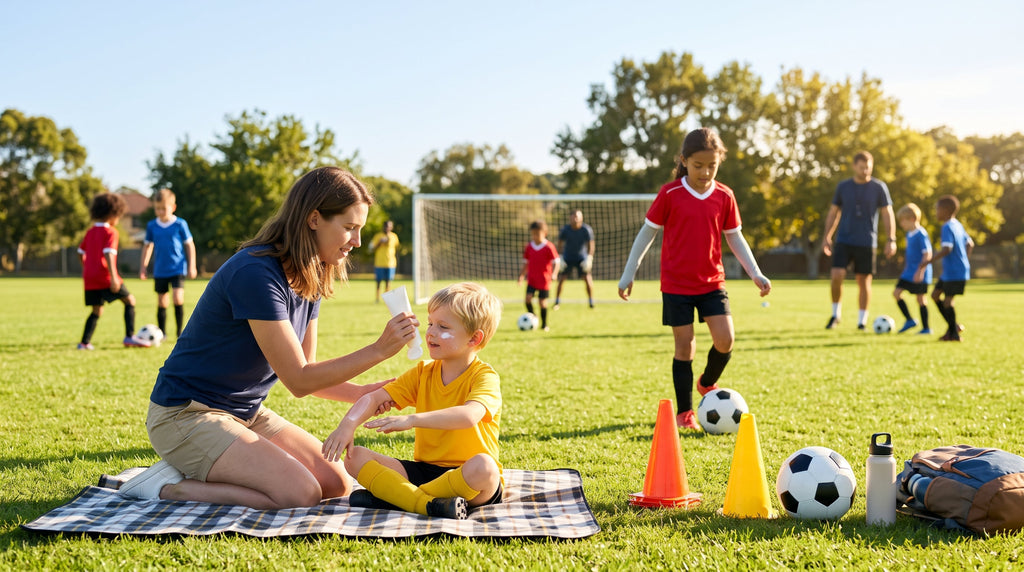
August means two things in our house: a backpack that still smells like the store, and a practice schedule taped to the fridge. Football, soccer, cross-country—they all start the same week, and they all happen between 3:30 and 6:00 in the afternoon, which is exactly when the sun is doing its worst work on a bare field. I product-manage sun gear for a living and I still got this wrong with my own nephew two seasons ago: great sunscreen, applied once at 2 p.m., gone by the first water break. He came home with a neck burn shaped like his jersey collar. If you've ever wondered what those UPF numbers on sportswear actually guarantee, our plain-English breakdown of UPF 50 ratings is worth two minutes before you buy anything. This article is the practical version: what to put on a kid for practice days so sun protection survives sweat, grass stains, and a twelve-year-old's complete indifference.
Why Practice Fields Are Tougher on Skin Than You Think
Game days get all the attention—shade tents, team umbrellas, parents with coolers. Practice is where the real UV exposure stacks up. Two hours on an open field, four or five days a week, for ten to twelve weeks: that's easily a hundred hours of late-afternoon sun per season, per kid. Dermatologists talk about cumulative exposure, and youth sports are one of the biggest delivery systems for it.
Three things make practice fields worse than a day at the park. First, timing: most school practices run from mid-afternoon to early evening, catching the tail end of peak UV hours. Second, surface: grass reflects about 5% of UV back up, but the turf fields more schools are installing can reflect considerably more, plus they radiate heat that makes kids sweat sunscreen off faster. Third, there's no shade structure at all—no trees, no pavilion, just field. A kid standing in a midfield huddle is a kid in full sun.
The Sunscreen Problem Nobody Talks About at Sign-Up
I'm not anti-sunscreen. It's the right tool for faces, hands, and any skin clothing can't cover. But as the only plan for a three-hour practice, it fails in predictable ways:
It sweats off. "Water-resistant 80 minutes" is a lab number. A kid doing suicides in 90-degree heat blows through that in half the time.
Nobody reapplies it. Reapplication every two hours assumes a responsible adult with a free hand and a willing kid. At practice, you have a coach running drills and a kid who would rather eat grass than stand still for a sunscreen break.
Application is a morning-afterthought. Sunscreen applied at 7 a.m. before school is chemically done by the 4 p.m. practice. The protection window closed during math class.
The fix isn't nagging harder. It's moving protection from something that wears off to something that can't: fabric.
Arm Sleeves: The Lowest-Drama Layer Kids Actually Keep On
I've put a lot of gear on a lot of kids over the years—samples, prototypes, hand-me-downs—and the gear that survives contact with children is the gear that asks nothing of them. Pull it on, forget it. That's the whole case for arm sleeves at practice.
A UPF 50+ sleeve blocks about 98% of UV on covered skin, and unlike sunscreen it doesn't care about sweat, water breaks, or whether your kid remembered anything that morning. The cooling knits actually help in August heat: once sweat starts moving through the fabric, evaporation does the same job it does on bare skin, minus the burn. Kids who refuse long sleeves in summer will often keep sleeves on because they genuinely feel cooler.
Sizing is the one place parents stumble. Youth arms are skinny, and an adult sleeve slides to the elbow in twenty minutes. Measure the fullest part of the bicep and look for a youth size with a silicone gripper band up top. The Finvizo arm sleeves multipack runs youth sizing alongside men's and women's, which matters more than it sounds—the same pack can outfit a kid and the parent coaching from the sideline.
Neck Gaiters: Covering the Spot Sunscreen Always Misses
Ask any dermatologist where they see the most sun damage on outdoor athletes and "neck and ears" comes up immediately. It's the zone sunscreen gets applied to once, thinly, and sweated off first. It's also exactly where jersey collars and helmet straps rub it away.
A lightweight cooling gaiter solves this without a fight. Worn loose around the neck it covers the collar line; pulled up it covers ears and the back of the neck under a cap. For football and lacrosse kids already wearing helmets, a thin gaiter doubles as a sweat-wicking liner. My rule of thumb: if the sport involves a cap or helmet, the gaiter goes under it; if it doesn't, the gaiter stays around the neck as a collar.
The catch with kids is loss rate, so I buy accordingly. A four-pack of cooling neck gaiters costs less per piece than replacing one "nice" gaiter twice, and the multi-pack math is honestly the whole point for practice season—which brings me to the system that actually works.
Building a Week-of-Practice Rotation That Survives August
Here's the system we landed on after two seasons of trial and error, and it maps almost embarrassingly well onto multipack sizing:
One set per practice day, minimum. A worn sleeve-and-gaiter set goes straight into the hamper. Trying to stretch one set across a week means a sweaty, stretched-out set by Wednesday that a kid will refuse to wear by Thursday.
Wash in the regular load, skip the softener. Cold wash, hang dry, no fabric softener—softener coats the fibers and kills both the wicking and the gripper's tack. UPF fabric holds its rating through a full season of washes if you treat it like athletic wear, which it is.
Label everything. A laundry marker on the inside hem has returned more gear to our house than any lost-and-found ever would.
Keep a spare set in the gear bag, permanently. Not "remember to pack it"—it lives in the bag next to the cleats. The day your kid forgets is the day of the scrimmage in direct sun. For families starting from zero, a gaiter-and-sleeves combo set is the cheapest way to build the first rotation and figure out what your kid will actually wear before stocking up.
Total cost for a full week's rotation lands under what most families spend on sunscreen in a single season—and unlike sunscreen, the sleeves are still working in week ten.
Frequently Asked Questions
Are arm sleeves allowed in youth football and soccer?
Almost universally, yes. Most youth leagues follow high-school federation rules, which treat sleeves as undergarments. The common restrictions are cosmetic: some leagues require sleeves to match the jersey or be a solid team color, and anything with hard padding needs referee approval. Check your league's uniform policy, but plain solid-color sleeves pass nearly everywhere.
What UPF rating do kids need for outdoor sports?
UPF 50+ is the target. It blocks roughly 98% of UV radiation, and the rating holds regardless of how much the kid sweats—unlike sunscreen, there's no reapplication window to miss. Anything below UPF 30 isn't worth buying for all-afternoon exposure.
My kid refuses to wear anything extra in the heat. What works?
Start with the cooling argument, because it's true: a dampened cooling sleeve or gaiter actively lowers skin temperature through evaporation, and kids feel the difference within minutes. Let them pick the color. And skip the lecture—most kids come around the first practice they spend cooler than their teammates.
How do I size arm sleeves for a child?
Measure the fullest part of the relaxed bicep. Most kids aged 8-14 land in a youth or small adult size. The sleeve should stay up without the gripper leaving a mark—if you see a red band after an hour, it's too tight; if it's at the elbow by halftime, it's too loose.
Do kids still need sunscreen if they wear sleeves and a gaiter?
Yes, but only on what fabric doesn't cover: face, hands, and any gap between sleeve and glove or gaiter and cap. That's a two-minute application instead of a full-body session, and it's a surface small enough to actually reapply at a water break.
Building out the rest of the family's outdoor kit for fall? Our essential camping gear checklist covers shelter, sleep, and sun protection in one pass—useful whether you're car camping or just surviving tournament weekends.
Related reading
- Volleyball Arm Sleeves: Why Players Wear Them & Top Picks
- Do Arm Sleeves Actually Keep You Cool? Here's the Science
- Cooling Towel vs Regular Wet Towel: Does It Actually Work Better?

Vivian J is a Product Manager at Finvizo and an avid outdoor enthusiast. She tests gear on real trails and writes from hands-on field experience to help readers choose equipment that performs reliably outdoors.