Why Is My Tent Wet Inside? Condensation Causes & Fixes
TL;DR: If your tent is wet inside but it didn't rain, that's condensation — warm, moist air from your breath and body hitting cold tent fabric and turning back into water. One camper can release close to a liter of moisture overnight. The fixes: ventilate (open doors and vents, even in light rain), pick a breezy site, keep wet gear out, and never cook inside. A tent with dual mesh doors makes all of this dramatically easier.
The first time it happened to me was a October weekend in the Alleghenies. I woke up at 6 a.m., reached up, and my hand came back soaked. My sleeping bag had dark wet patches, water beaded along the ceiling, and my first thought was the rainfly had failed. Except it hadn't rained a single drop all night — the "rain" came from me, my tentmate, and two days of damp gear stuffed in the corners.
If you've already checked whether your shelter can actually handle weather — our breakdown of how waterproof pop up tents really are covers ratings and seam sealing — and everything looked fine, this guide is the other half of the story.
Why Your Tent Gets Wet (It Usually Isn't a Leak)
Condensation is simple physics. You exhale and sweat out moisture all night — most outdoor references put it at roughly a pint to a quart per person. Add a second camper, a wet jacket, or a damp dog, and the air inside your tent gets humid fast. When that warm, moist air touches tent fabric cooled by the outside air, the water vapor turns back into liquid right on the inside wall.
Three things make it worse:
- Big temperature swings. Fall and spring are peak season — a 72°F day followed by a 45°F night guarantees a cold rainfly by 3 a.m.
- Sealed-up tents. Every zipped door and closed vent traps more humid air inside.
- Bad campsites. Low spots, riverbanks, and depressions collect cold, moist air. Your tent basically sits in a humidity bowl.
Here's the part that surprises people: even a perfectly waterproof tent condenses. Waterproofing stops water coming through the fabric — it does nothing about water forming on the fabric from the inside.
6 Condensation Fixes That Actually Work

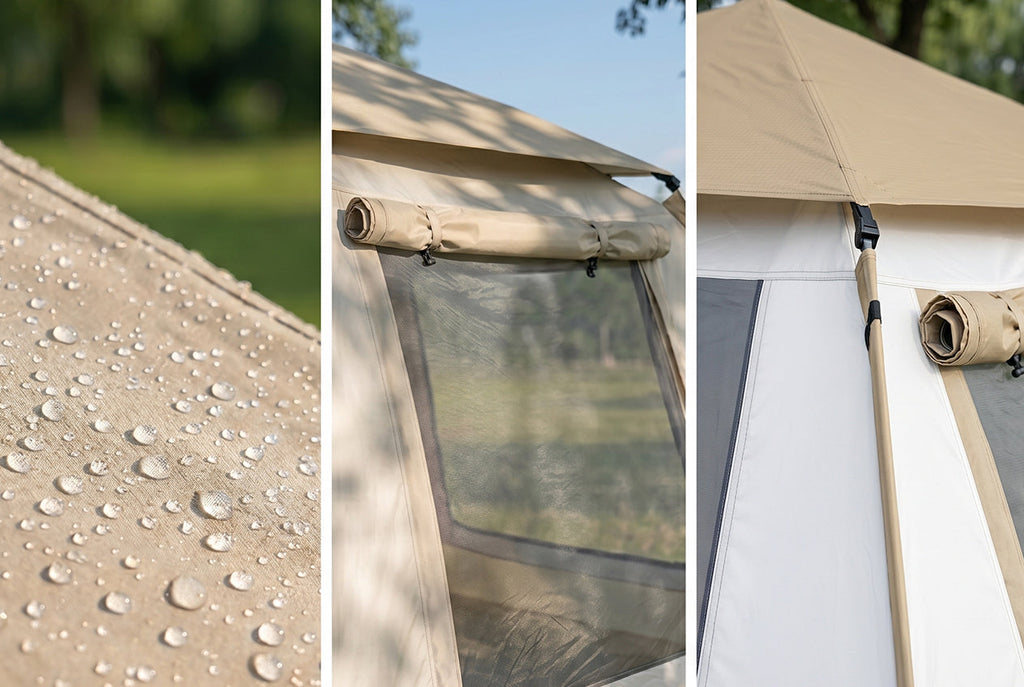
1. Ventilate like you mean it. Open every vent and crack both doors at least a few inches — yes, even when it's drizzling. Cross-flow is what carries moist air out before it settles on the walls. This is exactly why I like tents with dual mesh doors: the Finvizo pop up tent has two large mesh doors opposite each other, and with both cracked you get a real breeze path through the sleeping area instead of a single stuffy opening.
2. Pick your site with airflow in mind. A slight rise or ridge edge beats the flat spot next to the creek every time. Avoid pitching in depressions, and if you camp near water, expect more moisture and compensate with more ventilation.
3. Keep wet gear out of the sleeping area. Rain jackets, soaked socks, muddy boots — each one is a little humidifier running all night. Stash them under the rainfly edge, in a vestibule, or hang them outside under cover. A tent with a real porch or vestibule (like the 3-8 person porch tent) gives damp gear its own room so it doesn't share yours.
4. Never cook inside the tent. Boiling 500 ml of water for freeze-dried dinner dumps that moisture straight into your tent air. Cook under a tarp or the open vestibule instead — it's also a carbon monoxide safety rule, not just a comfort one.
5. Wipe down in the morning. Keep a small pack towel clipped inside the door. Sixty seconds of wiping the walls before you pack up means you don't unroll a wet tent into its carry bag — which is how you get mildew and that permanent locker-room smell.
6. Use the rainfly correctly. A double-wall setup with an air gap between inner tent and rainfly is your friend: condensation forms on the fly (outside your living space) instead of the inner wall. Make sure the fly is staked out taut so it never touches the inner tent — contact points are drip points.
How to Tell Condensation from a Real Leak
Quick field test: condensation shows up as a uniform film of fine droplets across large areas of fabric — ceiling, upper walls, everywhere at once. A leak is localized: a drip line from a seam, a wet spot under a stress point, or water tracking down one pole. If the wetness is evenly distributed and your gear near the walls is damper than gear in the center, it's condensation.
If it does turn out to be a seam leak, that's a different fix — seam sealer and a waterproofing refresh, which we cover in the tent maintenance guide. And if you're shopping for a tent that handles both problems well, the Finvizo camping tent collection is built around double-wall designs with taped seams and dual-door ventilation — the two features that matter most for staying dry from both directions.
FAQ
Does a waterproof tent stop condensation?
No — and this is the most common misunderstanding. Waterproof ratings (like a 150D oxford fabric with a water-resistant coating and taped seams) stop rain coming through the fabric. Condensation forms on the inside surface from your own breath and body moisture, so only ventilation and site choice control it.
Is condensation worse in winter?
It's worse whenever the gap between inside and outside temperature is large — cold fall and spring nights are the peak. In true winter camping it can be even more dramatic, because your breath freezes on the walls and then melts into drips when the sun hits the tent in the morning.
Will a tent with more mesh fix condensation completely?
It helps enormously, but nothing eliminates it entirely. Full-mesh inner tents with a properly gapped rainfly handle 90% of conditions; the remaining 10% is still your job — site choice, keeping wet gear out, and cracking doors even when you'd rather stay sealed up and cozy.
Why is my tent wet underneath the floor?
That's ground moisture, not condensation. A footprint or tarp under the tent blocks it, but make sure the footprint doesn't stick out past the tent edges — an exposed edge collects rain and channels it directly under your floor.
Should I leave my tent set up to dry when I get home?
Yes, always. Even if it feels dry, pack-away moisture hides in seams and corners. Set it up in the garage or drape it over chairs for 24-48 hours before long-term storage. A tent stored damp will mildew in weeks and the waterproof coating degrades far faster.
Related reading
- What Is a Tent Footprint? Do You Need One?
- Tents with Screen Porches: The Bug-Free Lounging Guide
- 4 Person vs 6 Person Tent: Which Size?

Vivian J is a Product Manager at Finvizo and an avid outdoor enthusiast. She tests gear on real trails and writes from hands-on field experience to help readers choose equipment that performs reliably outdoors.