Camping Cot vs Air Mattress: Which Sleeps Better?
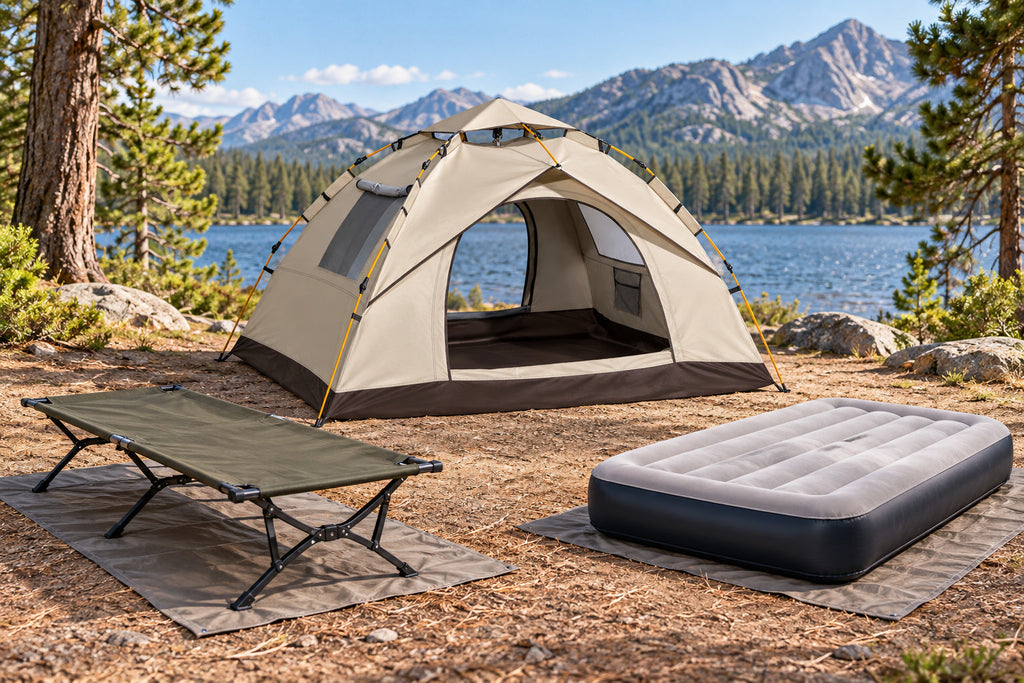
Camping cot vs air mattress: camping cot vs air mattress comfort depends on your body, conditions, transport, and tent, so there is no universal winner. Measure the assembled bed and shelter first. The Finvizo 2–4 Person Instant Pop Up Tent is a planning example, but no cot, mattress, pump, bedding, or protector is included.
What Changes Comfort, Warmth, and Tent Fit?
A cot provides a tensioned, elevated surface and space beneath it. It is often firm and convenient for sitting, but legs concentrate force on the floor. Moving air beneath you can feel cold without suitable insulation.
An air mattress offers a broad cushioned surface and adjustable firmness. It needs inflation access and a repair plan. Uninsulated air can also feel cold, and thickness alone is not a verified thermal-resistance value.
Transport changes the answer. For a drive-in campsite, you may accept a heavier frame, larger mattress, or powered pump. When you must carry everything farther, compare complete packed weight and volume, including insulation, pump, repair kit, protectors, and bedding—not just the main bed.
Use an ASTM F3340-tested R-value when available to compare camping-mattress thermal resistance. The ASTM F3340 standard explains the standardized measurement context. Do not invent an R-value for a cot, mattress, or topper.
The Finvizo 2–4 Person Instant Pop Up Tent offers 2-person and 4-person variants, listed weights of 5.5 and 6.6 pounds, a preassembled hydraulic frame, and setup listed under 60 seconds. Capacity labels alone do not prove bed fit.
Cot and Air Mattress Comparison
| Factor | Cot | Air mattress | Verify |
|---|---|---|---|
| Support | Firm, tensioned | Adjustable cushion | Your comfort |
| Cold | Air beneath | Air chamber | Verified insulation |
| Floor contact | Concentrated feet | Broad rubbing | Allowed protection |
| Space | Height and rigid frame | Inflated footprint | Door and walls |
| Failure | Joint or fabric | Leak or pump | Backup plan |
How to Choose and Arrange a Tent Sleep System
- Define the Trip and Overnight Conditions. Record access, expected low temperature, moisture, trip length, and backup options.
- Measure the Campers and Their Comfort Needs. Note height, width, firmness preference, mobility needs, sleeper count, and shared or separate surfaces.
- Measure the Cot or Inflated Mattress. Use full length, width, height, feet, valve access, and bedding overhang when assembled.
- Verify Tent Interior and Door Dimensions. Compare floor geometry, sloping walls, peak height, doorway, poles, vents, and exit path.
- Plan Insulation Separately From Cushioning. Choose verified insulation for conditions instead of treating cot elevation or air thickness as an R-value.
- Protect the Floor and Keep Safe Clearances. Use approved protection, avoid sharp hardware, keep bedding from wet walls, and preserve doors and vents.
- Set Up and Test at Home. Confirm doorway access, assemble or inflate, lie down, sit up, turn, and verify exits.
- Pack a Failure and Comfort Backup. Inspect cot joints and feet or carry a compatible patch and pump; bring suitable ground insulation.
A fully assembled cot may not pass through the door. An inflated mattress may fit the floor but touch sloping walls or block the exit. Measure usable interior geometry and doorway clearance from the current seller page or directly from your tent.
Draw a scaled floor plan if you are arranging multiple sleepers. Include the widest point of each bed, cot feet, valves, bags, and a clear route to the door. Then check vertical clearance at the bed edges, where sloping walls reduce usable space most quickly.

Our Pick: Finvizo 2–4 Person Instant Pop Up Tent
Our shelter-planning example is the Finvizo 2–4 Person Instant Pop Up Tent. Its verified preassembled hydraulic spring frame has setup listed under 60 seconds, while 150D Oxford fabric with taped seams, dual mesh doors/windows, and a detachable rainfly describe the enclosure.
No cot, air mattress, pump, bedding, topper, or floor protector is listed as included. Neither sleep system is automatically compatible. Verify assembled dimensions, doorway access, sloping-wall and roof clearance, exit space, ventilation, and tent-maker-approved floor protection.

Tips and Best Practices
Choose a cot when firm elevation, sitting height, and car access matter, provided the tent and door accommodate it. Check feet for sharp edges and follow both makers’ instructions.
Choose an air mattress when you prefer a broad cushioned surface and can support inflation, repair, and insulation. Measure it fully inflated; package dimensions do not predict tent fit.
Keep the door and vents clear. Do not let tall bedding press against wet walls or roof fabric. Maintain a usable exit route for every sleeper and protect the floor only with materials the tent maker permits.
The National Park Service camping-safety guidance warns about carbon monoxide. Never use fuel-burning heaters, grills, or stoves inside a tent or enclosed sleep system.
Common Setup Mistakes
Do not buy from person capacity alone, forget the doorway, ignore sloping walls, or equate cushioning with insulation. Do not put sharp or unprotected cot feet on the floor, and do not block ventilation or exit space.
Test at home with actual bedding and sleepers. Sit, turn, enter, exit, and reach the valve or cot joints. A layout that fits on paper can still make movement unsafe or uncomfortable.
Inspect again the morning after your test. Lost mattress pressure may reveal a valve or leak issue, while shifted cot feet can reveal inadequate protection. This overnight check gives you better evidence than a brief showroom trial.

Whichever sleep setup wins, it still lives inside a shelter — our Finvizo Instant Pop Up Tent runs $109.99 for the 2-person size and $119.99 for the 4-person (was $129.99/$139.99), pitches in about 60 seconds with a hydraulic frame, and either size swallows a cot or a queen air mattress without touching the walls.
FAQ
Is a camping cot warmer than an air mattress?
Not automatically. Air beneath a cot and uninsulated air inside a mattress can both feel cold. Compare verified R-values and plan insulation for conditions.
Which is better for side sleepers: a cot or air mattress?
It depends on support and pressure preference. A cot is usually firmer; an air mattress is cushioned and adjustable. Test the exact model.
How do you know whether a cot fits inside a tent?
Compare assembled length, width, height, feet, and bedding overhang with floor geometry, sloping walls, peak height, doorway, vents, and exit path.
Can cot feet damage a tent floor?
Yes. Feet concentrate loads and may abrade or puncture. Follow both makers and use only approved floor protection without blocking drainage, doors, or vents.
Does the Finvizo 2–4 Person Tent include a cot or air mattress?
No cot or mattress is listed as included. Both are separately selected and not automatically compatible; verify dimensions, access, clearances, ventilation, and protection.
Measure the Shelter, Then Build the Sleep System
Define conditions, measure every assembled component, plan insulation, preserve exits and vents, and test at home. Review the Finvizo 2–4 Person Instant Pop Up Tent or compare Finvizo tents.
Related reading
- Colorado High Altitude Camping: Gear for Thin Air
- FINVIZO Camping Tent Review
- Camping Gear Feature Comparison Guide

Written by Vivian J
Product Manager at Finvizo and an avid camper who tests gear on real trails. She writes from hands-on field experience to help you pick equipment that actually holds up outdoors.