Push vs Pull Wagons: Which Handle Saves Your Back?
Push vs Pull Wagons: Which Handle Saves Your Back?
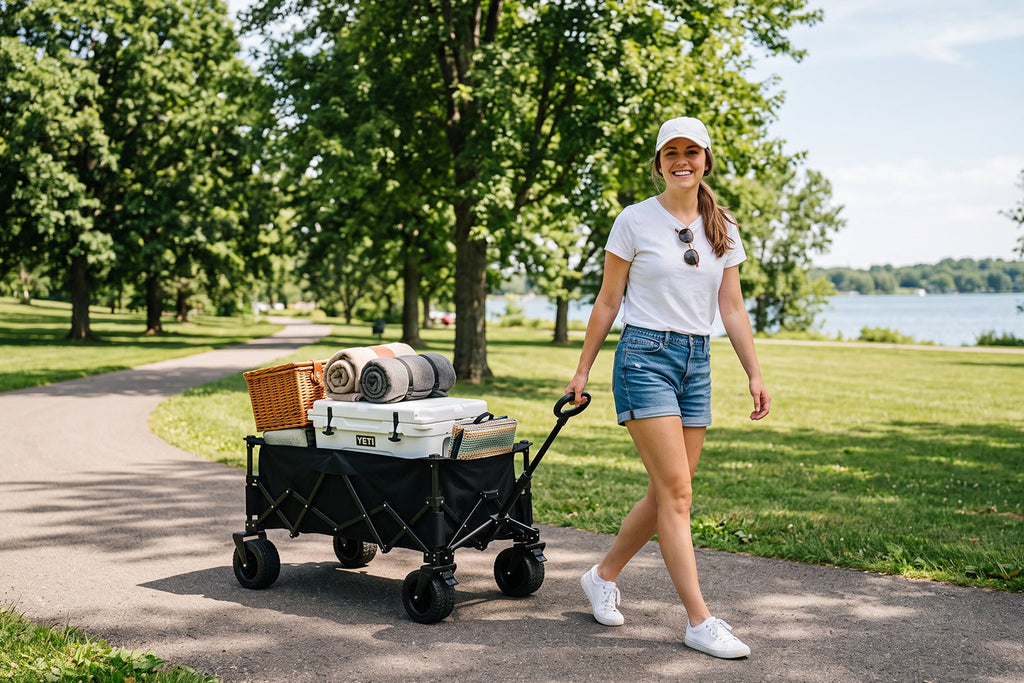
A push wagon keeps your spine upright; a pull wagon rules sand and gravel. The best push wagon setup is one handle that does both: pulling loads your shoulders and lower back, pushing lets your legs drive. An angle- and height-adjustable handle lets you switch as terrain changes.
If you haul coolers, tents, or kids' gear every weekend, wagon handle ergonomics matter more than wheel size. A back-friendly wagon starts at the handle: height, grip angle, and how easily you swap between pushing and pulling. We use the Finvizo Collapsible Wagon Cart 600 LBS as our reference throughout.
What to Look for in a Wagon Handle (Ergonomics First)
Handle height and your posture
A handle at roughly hip to waist height keeps your arms relaxed and spine neutral. Too low and you stoop; too high and your shoulders shrug. An adjustable wagon handle with a telescoping design fits different heights.
Grip angle and wrist alignment
Wrist strain from wagon pulling usually comes from a fixed, flat grip that forces your wrist into extension. An angled grip keeps your wrist straight and cuts forearm fatigue.
Push vs pull mechanics: what changes for your spine
When you pull, you lean back slightly and recruit your lower back and shoulders. When you push, you stay upright and larger leg muscles do the work. That difference explains most wagon-related back pain.
Terrain and handle control
On loose ground, pulling gives better wagon steering control because the front wheels follow your line. On pavement, pushing tracks smoother with less arm fatigue.
Top Picks: Wagons with Back-Friendly Handles
Our Pick: Finvizo Collapsible Wagon Cart 600 LBS — Best Adjustable Handle
The Finvizo Collapsible Wagon Cart 600 LBS ($269.99) is built around a handle that adjusts for both angle and height, so you can pull it across a bumpy trail and push it down a long boardwalk without changing posture.
Two details seal the deal: a 600 lb load capacity in a 600D Oxford fabric body, and 3.6-inch wide wheels with 360-degree rotation and brakes. It folds in seconds without tools—press center to open, pull center to fold—storage bag included.

Other handle styles on the market
Many popular folding wagons, including Mac Sports-type models, use a fixed-length pull handle. Fine on short hauls, but they lock you into one posture and pulling style, which taller users and anyone with back issues notice first.
Quick comparison: handle types

| Handle Type | Adjustability | Best Terrain | Posture Impact |
|---|---|---|---|
| Fixed pull handle | None | Short, flat hauls | One-size posture; can strain wrists |
| Height-adjustable only | Telescoping length | Mixed, mostly flat | Better for tall/short users |
| Angle + height adjustable (Finvizo) | Angle and height | Sand, gravel, and pavement | Neutral spine push or pull |
Push vs Pull Wagon: An Honest Ergonomic Breakdown
When pulling wins
Pulling is your friend on sand, gravel, grass, and curbs. Dragging the wagon lifts the front wheels slightly, helping them roll over obstacles instead of digging in. A steady beach wagon pulling technique beats pushing off pavement.
When pushing wins
On flat pavement and long distances, pushing is easier to sustain: your body weight sits behind the load, your legs drive, steering stays precise. A wagon with push handle use in mind keeps heavy loads tracking straight.
What ergonomics research says
NIOSH ergonomics guidance and its ergonomic guidelines for manual material handling generally favor pushing over pulling for heavy loads: pushing engages larger muscle groups and keeps the spine closer to neutral, lowering lumbar stress.
Why an angle- + height-adjustable handle covers both
No single fixed handle wins everywhere. A push pull wagon with an adjustable handle lets you angle it for pulling on rough ground, then reposition for upright pushing on pavement. That flexibility is what saves your back all day.
Push vs Pull: Side-by-Side
| Factor | Pulling | Pushing |
|---|---|---|
| Spine posture | Slight lean-back, more lumbar load | Upright, legs drive |
| Wrist/shoulder load | Higher | Lower |
| Best terrain | Sand, gravel, curbs | Flat pavement, long distance |
| Heavy loads (toward 600 lb) | Harder to start | Easier sustained |
| Control downhill | Good | Needs brakes (Finvizo 360° wheels include brakes) |
Who Should Buy What
Beach & trail families
You need a collapsible wagon with handle geometry tuned for pulling: angled grip, wide wheels, easy steering. Prioritize pull comfort, then enjoy push mode on the boardwalk.
Campers hauling heavy gear on pavement
If most of your route is parking lots and campground roads, ergonomic hauling means pushing. Look for swivel wheels with brakes and a heavy duty wagon handle at hip height.
Anyone with existing back or wrist issues
Don't gamble on a fixed handle. Choose a wagon whose handle adjusts in height and angle so you can pick the motion your body tolerates that day—and switch mid-trip.

FAQ
Is it better to push or pull a wagon?
Pushing is gentler on your lower back on flat ground because your spine stays upright; pulling gives better control on sand, gravel, and curbs. An adjustable-angle handle lets you do both.
Does pushing a wagon reduce back strain?
Yes—ergonomics guidance favors pushing over pulling for heavy loads because larger leg muscles do the work and the spine stays neutral, reducing lumbar stress.
What handle height should a wagon have?
A handle at roughly hip to waist height keeps your arms relaxed and spine neutral. Adjustable-height handles, like the Finvizo wagon's, fit different user heights.
Can one wagon handle both pushing and pulling?
Yes. A wagon with an angle- and height-adjustable handle plus 360° swivel wheels with brakes can be pulled on rough terrain and pushed on flat surfaces.
The Bottom Line
The push vs pull debate has no single winner—terrain decides. Pull on sand and gravel, push on pavement, and let your handle adapt instead of your back. The Finvizo Collapsible Wagon Cart 600 LBS delivers that flexibility: adjustable angle and height handle, 600 lb capacity, tool-free folding, $269.99. Browse our camping cart collection.
Related Guides:
- Shop the Finvizo Camping Cart Collection
- Finvizo Collapsible Wagon Cart 600 LBS — Full Specs & Pricing
- Cheap vs Heavy Duty Wagon Cart : Is It Worth Paying More?
- Best Collapsible Wagons for Camping and Beach Trips

Written by Vivian J
Product Manager at Finvizo and an avid camper who tests gear on real trails. She writes from hands-on field experience to help you pick equipment that actually holds up outdoors.