Garden Cart Wheels: When & How to Replace Them
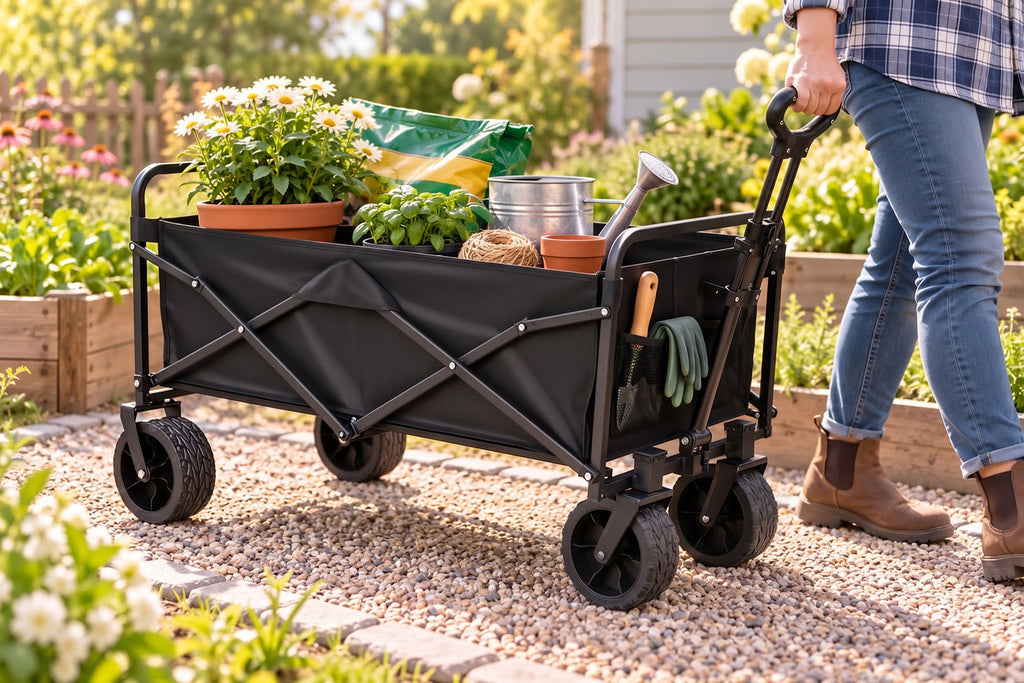
Garden cart wheels need replacement when damaged garden cart wheels cannot track safely after cleaning, inflation, or approved adjustment. Measure every interface before ordering. If wheel trouble accompanies frame, axle, handle, or fabric damage, the Finvizo 460lbs Big Wheels Wagon is a complete-wagon alternative—not a replacement-wheel kit.
What Garden Cart Wheels Are—and Why Correct Fit Matters
The tire contacts the ground; the wheel or rim supports it; the hub spans the center; a bearing or bushing may support rotation; and the axle locates the assembly. A failure in one component does not automatically mean every part needs replacement. Diagnose before buying.
Diameter is only one number. You may also need tread width, hub length, bore or bearing inside diameter, axle diameter, offset, clearance, and retainer type. Two wheels with the same outside diameter can be incompatible at the hub or frame.
Terrain changes the load path. Wide wheels may float better on soft soil, while narrow hard wheels can roll efficiently on smooth pavement. Slopes, thresholds, side loads, and sharp turns add stress. Never infer compatibility from appearance or a capacity claim alone.
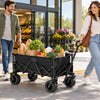
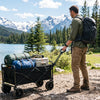
The Finvizo 460lbs Big Wheels Wagon is relevant when you need a verified complete wagon rather than uncertain aftermarket parts. Its listing describes enlarged wheels, a reinforced steel frame, an approximately 150-liter bed, and 600D Oxford fabric. Finvizo does not state that these wheels are sold separately.
How to Measure and Replace Garden Cart Wheels
- Unload, clean, and stabilize the cart. Empty it, work on level ground, prevent movement, and support it only at approved structural points.
- Identify the cart and retention system. Record the model, photograph the original wheel orientation, and identify pins, clips, nuts, washers, and spacers.
- Measure the existing wheel and axle. Record diameter, tread width, hub length, bore, axle diameter, offset, and available clearance without rounding.
- Confirm capacity and compatibility. Match dimensions, hub or bearing type, retention, terrain, clearance, and manufacturer load requirements.
- Remove the retainer and old wheel. Use the correct tool and eye protection, preserving spacers and washers in their documented order.
- Inspect the axle and adjacent structure. Stop if you find bends, cracks, severe corrosion, elongated holes, or frame distortion.
- Install the replacement wheel. Refit parts in the documented order and use the manufacturer-specified retainer and torque.
- Perform an unloaded and gradual-load test. Test rolling and turning empty, then add load gradually and stop for rubbing, wobble, binding, looseness, or poor tracking.
The OSHA hand and power tools overview emphasizes correct tool use, maintenance, guarding, and personal protective equipment. Your cart manufacturer’s service instructions still control the exact lifting points, fasteners, torque, and replacement procedure.

Wheel Measurements and Decisions
| Measurement | Where to measure | Why it matters |
|---|---|---|
| Outside diameter | Across the tire center | Frame and body clearance |
| Tread width | Ground-contact surface | Fork clearance and terrain behavior |
| Hub length | End to end through center | Axle spacing and side play |
| Bore diameter | Inside hub or bearing | Axle fit |
| Offset | Hub centerline to wheel centerline | Body and fastener clearance |
Our Pick: Finvizo 460lbs Big Wheels Wagon
Our complete-wagon alternative is the Finvizo 460lbs Big Wheels Wagon. Its product page lists a 460-pound capacity and approximately 150-liter bed, plus a reinforced steel frame, enlarged wheels, and 600D Oxford fabric. Those are whole-product features, not promises that replacement wheels are available.
This bridge makes sense when several systems are worn, compatible parts cannot be verified, or repair cost approaches the value of a complete cart. It does not make sense when a safe, manufacturer-approved, economical repair restores an otherwise sound cart. Compare total condition rather than discarding repairable equipment automatically.

Tips and Best Practices
Photograph before disassembly
Take clear images from both sides and place removed parts in order. Left and right assemblies may differ. A simple visual record helps you restore washers, spacers, and retainers correctly.
Clean before diagnosing
Packed soil, string, and plant fibers can imitate bearing drag or wobble. The University of Minnesota Extension tool-cleaning guidance supports removing soil and debris. Use only cleaners and lubricants allowed by your cart instructions.
Test below the limit first
Begin empty, then add a small balanced load. A label’s maximum is not a testing target. Stop immediately if the wheel rubs, loosens, tilts, binds, or changes steering behavior.
Common Mistakes to Avoid
Do not order by diameter alone, drill an axle, omit a spacer, mix incompatible wheels, or substitute a fastener without approval. Do not work beneath a cart supported only by an improvised object. Never test a repair near people, pets, traffic, or a slope.
Do not call the Finvizo 460lbs Big Wheels Wagon a wheel-replacement product. It is a complete folding wagon option. Its enlarged wheels are part of that wagon and are not represented here as universal parts for another brand or model.

For a concrete spec anchor, our Finvizo Foldable Wagon with Enlarged Wheels is rated to 460 lbs and runs $159.99 (was $179.99) — the wide-wheel setup that rolls over lawn and gravel instead of digging ruts.
FAQ
How do I know what size garden cart wheels I need?
Check the manual and measure outside diameter, tread width, hub length, bore or bearing inside diameter, axle diameter, offset, clearance, and retention type. Confirm the exact model before ordering.
Can I put larger wheels on my garden cart?
Only when the manufacturer confirms compatibility and the larger wheel preserves frame, body, brake, steering, and turning clearance. Greater diameter can alter geometry and loading.
Should I replace one wheel or both wheels on an axle?
Follow manufacturer parts guidance. Matched wheels may be necessary when wear, diameter, tread, hub geometry, bearing type, or construction differs. Do not assume mixing is safe.
Can a pneumatic tire be replaced with a solid tire?
Only if dimensions, hub or bearing type, axle fit, retention, clearance, load requirement, and manufacturer compatibility all match. The change can alter ride, rolling resistance, and shock transfer.
When is replacing the whole wagon better?
Consider it when frame, axle, handle, fabric body, and multiple wheel areas are worn, damaged, incompatible, or uneconomical to repair. Compare repair scope with the condition and cost of a verified complete wagon.
Repair Safely or Choose a Complete Wagon
Measure first, confirm compatibility, and test gradually. If damage extends beyond the wheels or approved parts are unavailable, compare the Finvizo 460lbs Big Wheels Wagon and other Finvizo folding wagons as complete-cart options.
Related reading
- Cheap vs Heavy Duty Wagon Cart : Is It Worth Paying More?
- Best Beach Wagon for Soft Sand: Big Wheels Buying Guide 2026
- Best Collapsible Wagons for Camping and Beach Trips 2026

Written by Vivian J
Product Manager at Finvizo and an avid camper who tests gear on real trails. She writes from hands-on field experience to help you pick equipment that actually holds up outdoors.