How to Replace Tent Poles: A Quick Repair Guide
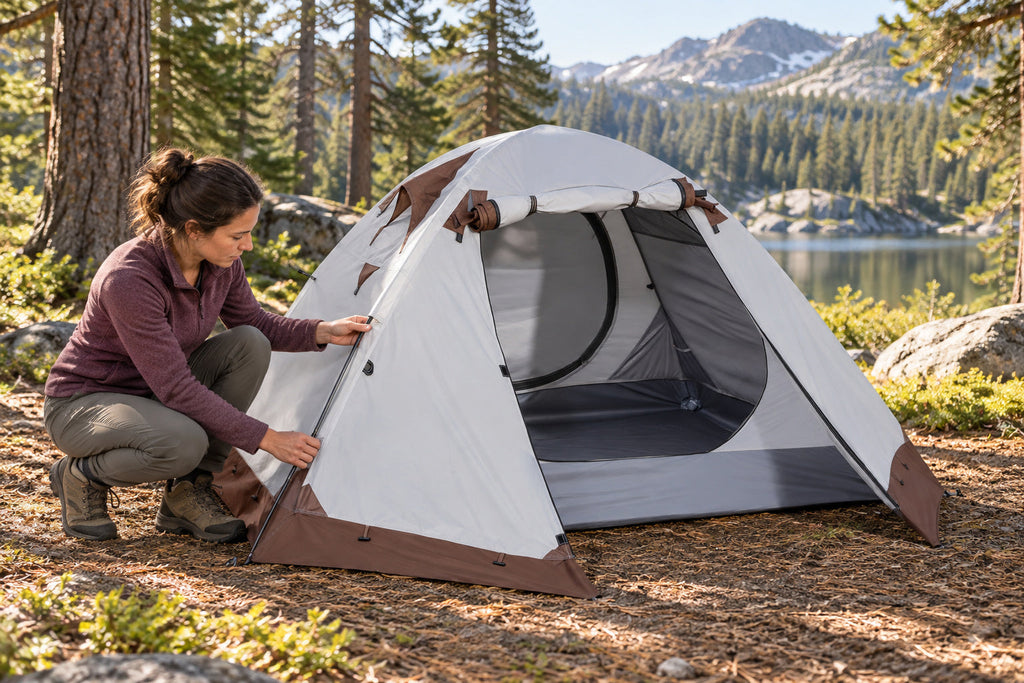
Replacement tent poles must match precisely; replacement tent poles with the wrong material, diameter, length, fittings, or geometry can damage a shelter or fail. A temporary sleeve may help you exit mild conditions. When damage is broader, the Finvizo 2-Person Backpacking Tent is a complete-tent alternative, not a pole kit.
What Replacement Tent Poles Are—and Why Exact Fit Matters
A tent pole is a structural system, not simply a tube. Material, outside diameter, wall thickness, segment length, ferrule depth, shock-cord tension, end tips, hubs, prebends, and total assembled geometry work together. A close visual match does not prove safe compatibility.
Individual segment length differs from total assembled length because ferrules insert into adjacent sections. Measure both, without rounding. Photograph color coding, crossing order, clips, sleeves, grommets, and end fittings before disassembly so you can restore the intended architecture.
Aluminum and fiberglass behave differently under bending and impact. You should not substitute one for another unless the tent manufacturer approves the full assembly. A stiffer or differently curved pole can transfer unusual force to fabric, seams, clips, or hubs.
The Finvizo 2-Person Backpacking Tent is relevant only when you need a complete shelter. Its page lists a 5.7-pound tent weight, 3500 mm water-resistance rating, full rainfly, and breathable inner layer. Finvizo does not state that its poles are sold separately or fit another tent.
How to Measure and Replace a Broken Tent Pole
- Move to a safe, low-stress work area. Remove fabric tension when conditions permit and move away from exposed wind or lightning risk.
- Identify the tent model and pole position. Record the model, color coding, crossing order, and attachment points before disassembly.
- Inspect the full pole assembly. Check every segment, ferrule, hub, tip, shock cord, sleeve, clip, and grommet for damage.
- Measure the required specifications. Record material, diameter, wall thickness if available, segment length, ferrule depth, assembled length, fittings, and bends.
- Find a manufacturer-approved match. Contact the tent maker or use its parts list before considering a specialist-fabricated replacement.
- Transfer or replace the shock cord correctly. Follow the pole maker’s instructions, preserve segment order, and control cord tension.
- Reassemble without forcing the joints. Seat ferrules fully and stop if a segment binds or creates abnormal fabric tension.
- Pitch and test the tent in mild conditions. Verify pole arcs, attachments, doors, fabric tension, and joint security before another trip.
The National Park Service pre-trip safety guidance recommends checking equipment, weather, and emergency preparations before departure. Inspect your repair at home and carry backup shelter appropriate to the route rather than making the next trip the first test.

Measurements You Need Before Ordering
| Specification | How to record it | Why it matters |
|---|---|---|
| Outside diameter | Use a suitable caliper | Ferrule, sleeve, and joint fit |
| Segment length | Measure each section | Arc and assembled geometry |
| Ferrule depth | Measure inserted and exposed portions | Joint engagement |
| Assembled length | Join the original sequence | Tent tension and shape |
| Tips and hubs | Photograph and identify | Attachment compatibility |
Do not publish or order from guessed measurements. If a crushed or splintered section prevents accurate measurement, use the manual, parts diagram, an undamaged matching pole, or manufacturer support. Universal marketing language never overrides actual geometry.
Our Pick: Finvizo 2-Person Backpacking Tent
Our complete-shelter alternative is the Finvizo 2-Person Backpacking Tent. The listing gives a 5.7-pound weight and 3500 mm water-resistance rating, with a full rainfly and breathable inner layer. These are whole-tent specifications, not evidence that separate Finvizo poles are available.
Consider whole-tent replacement when pole damage accompanies torn attachment points, failing seams, damaged fabric, broken hubs, or unavailable compatible parts. A new shelter can be more coherent than combining uncertain components. This recommendation does not mean its poles are universal or compatible with your existing tent.

Tips and Best Practices
Carry a correctly sized repair sleeve
A sleeve can splint some damaged sections temporarily, but it must fit the pole and remain clear of fabric hazards. Follow the manufacturer’s method. Tape alone is not a dependable permanent structural repair.
Control sharp edges
Splintered fiberglass and torn metal can injure you or cut the tent. Wear appropriate protection, avoid bare-hand contact with fibers, and isolate sharp surfaces while exiting. Replace damaged structural parts before reuse.
Leave exposed weather first
The National Weather Service lightning guidance states that no place outside is safe during thunderstorms. A tent is not lightning shelter. Move to a substantial building or hard-topped vehicle rather than repairing a pole in exposure.
Practice shock-cord work at home
Record segment order before releasing the cord. Use the specified diameter and tension, and prevent the cord from snapping back. If instructions are unavailable or the assembly includes a complex hub, seek qualified repair help.
Common Mistakes to Avoid
Do not force a thick ferrule into a narrow segment, shorten sections by eye, mix materials casually, or assume matching color means matching structure. Do not pitch under high tension to “make” an incompatible pole fit. Abnormal resistance is a stop signal.
Do not represent the Finvizo 2-Person Backpacking Tent as a source of replacement parts. It is sold as a complete tent. Its product claims apply to that assembled product and do not certify its poles for a different shelter.

Sometimes the math favors replacement over repair: a full Finvizo 2-Person Backpacking Tent runs $139.99 (was $159.99), so if a pole set plus shipping approaches half that, a new tent with a fresh warranty is the saner spend.
FAQ
How do I know which replacement tent poles will fit?
Match the tent model, material, diameter, wall thickness when available, segment and assembled lengths, ferrules, end fittings, hubs, bends, and geometry using manufacturer guidance. Diameter alone is insufficient.
Can a broken tent pole be repaired with tape?
Tape alone is not a dependable permanent repair. A correctly sized sleeve may temporarily stabilize some breaks so you can exit, followed by inspection and approved replacement. Avoid relying on a field splint for another trip.
Can I replace fiberglass tent poles with aluminum poles?
Not unless the manufacturer approves a complete match in geometry, stiffness, dimensions, fittings, and load behavior. The materials are not automatically interchangeable.
How do I measure a tent pole for replacement?
Record material, outside diameter, wall thickness if available, segment length, ferrule depth, total assembled length, end fittings, hubs, and prebends without rounding. Use an undamaged counterpart when necessary.
When should I replace the whole tent?
Consider a complete shelter when poles, fabric, seams, attachment points, and hardware have broader damage or a safe compatible pole cannot be sourced. Compare repair cost and reliability with a verified complete option.
Repair Precisely or Replace the Complete Shelter
Measure every interface, use manufacturer-approved parts, and test only in mild conditions. If damage extends beyond the pole, review the Finvizo 2-Person Backpacking Tent as a complete alternative or compare Finvizo tents.
Related reading
- 10 Best Family Camping Picks 2026
- FINVIZO Camping Tent Review
- What Is a Tent Footprint? Do You Need One?

Written by Vivian J
Product Manager at Finvizo and an avid camper who tests gear on real trails. She writes from hands-on field experience to help you pick equipment that actually holds up outdoors.