Trekking Poles vs Walking Sticks: Which Helps Your Hike?
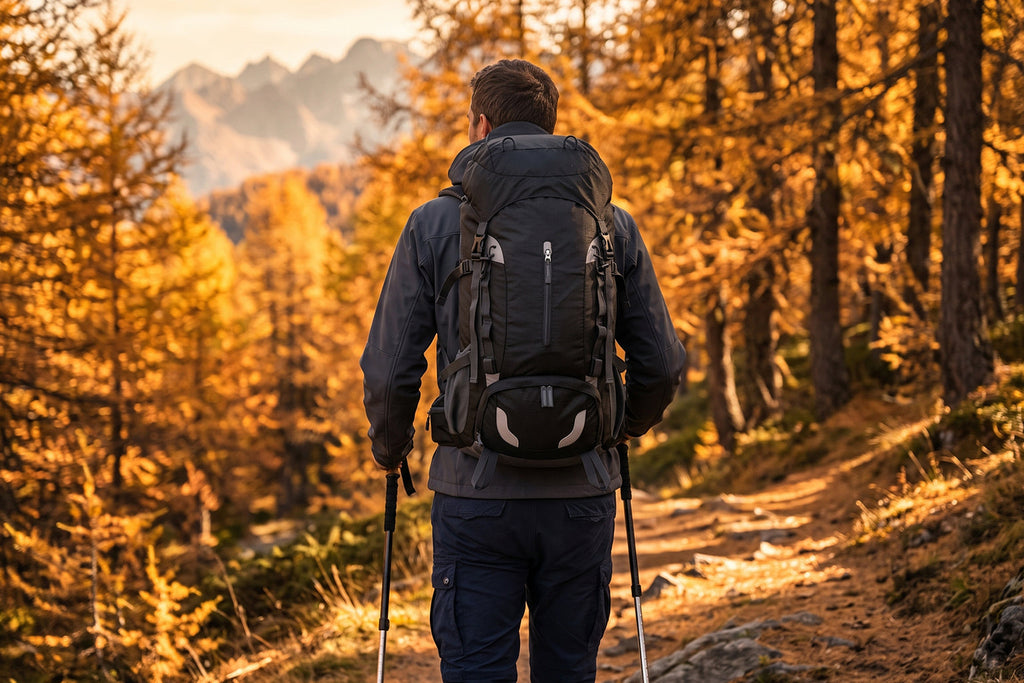
Trekking Poles vs Walking Sticks: Which Helps Your Hike?
Quick answer: hiking canes and walking sticks both add a third contact point on the trail, but walking sticks differ from trekking poles in design and purpose. Hiking canes and walking sticks aid balance, while trekking poles come in pairs with wrist straps to cut knee strain and shift load off your legs.
You feel the difference fast—especially under a pack like the Finvizo 55L with adjustable suspension. Research summarized by the National Park Service shows fatigue and falls are top trail risks, and poles can reduce downhill knee loading by roughly 25% while engaging your upper body.
Trekking Poles vs Walking Sticks — What's the Difference?
A walking stick (or hiking cane) is a single shaft, often wooden or fixed-length aluminum. You use it for balance, testing mud, or steadying yourself on uneven ground. It's simple, cheap, and needs no adjustment.
A trekking pole is adjustable, collapsible, and usually sold in pairs. Features like wrist straps, shock absorption, and carbide tips let you plant rhythmically and push with your arms, not just lean on the stick.

Key contrasts:
- Count: sticks come singly; poles work best as a pair.
- Adjustability: poles tune to your height and terrain; sticks rarely adjust.
- Load transfer: poles with straps shift real weight to your arms; sticks mostly aid balance.
- Packability: poles collapse to strap onto a pack; sticks don't.
How to Choose and Size Your Pole or Stick
Correct sizing matters more than brand. Follow these steps:
- Match terrain to tool. Flat day walks favor one stick; elevation and mileage favor paired poles.
- Set pole length on flat ground. Your elbow should bend at 90 degrees when the tip touches the floor.
- Shorten uphill, lengthen downhill. Drop 5–10 cm climbing; add 5–10 cm descending.
- Use wrist straps correctly. Slide your hand up through the loop, then grip, so the strap carries your push.
- Check your grip height with your pack on. A loaded hip belt raises your posture; retest your 90-degree angle.
- Test shock absorption. On rocky descents, anti-shock poles reduce wrist fatigue over long miles.
Weight Transfer: Poles for Your Legs, Suspension for Your Back
Here's the logic: poles manage the load on your legs; your backpack's suspension manages the load on your shoulders and hips. Optimizing one while ignoring the other leaves half the problem unsolved.
With proper wrist straps, poles can offload 10–15% of body weight per step on descents. Meanwhile, a load-bearing hip belt transfers up to 80% of pack weight from your shoulders to your hips.
Our Pick: Finvizo 55L Internal Frame Backpack

Pair your poles with the Finvizo 55L Internal Frame Backpack with Adjustable Suspension ($169.99). Its torso-adjustable suspension system fits your exact back length, and the load-bearing hip belt with breathable padding moves weight to your hips to cut fatigue.
Even better for this topic: adjustable straps on both sides and the top let you lash trekking poles, sleeping bags, or tents externally—so your sticks ride securely when your hands need a break.
At 3.37 lbs with 55 liters of organized space and a bottom compartment holding a rain cover, it's built for multi-day trekking, thru-hiking, and mountaineering where smart load transfer matters most.
Common Mistakes to Avoid
- Wrong length: a stick sized for flat ground will jam your shoulders on descents.
- Ignoring straps: gripping without the wrist strap wastes the load transfer you paid for.
- One pole only: using a single trekking pole on steep terrain creates an uneven gait.
- Overloading your pack: stay under your pack's max capacity—the Finvizo tops out at 50 lbs.
- Skipping backcountry prep: review the NPS backcountry camping guide before overnight trips.

Weight, Materials, and Numbers That Matter
A quality aluminum trekking pole weighs about 7 to 10 ounces per pole; carbon fiber trims that to roughly 5 to 8 ounces at around double the price. Adjustable poles typically collapse to 24 to 26 inches and extend to 50 to 55 inches, so one pair fits most hikers from about 5 feet to 6 feet 4 inches tall. A finished wooden walking stick is simpler: 16 to 24 ounces at a fixed length, usually 48 to 60 inches, so sizing happens at the saw rather than with a flick lock.
On the trail, poles can shift 10 to 20 percent of your pack load off your knees on descents — a real difference when your pack carries a weekend of gear. My own Finvizo 55L hiking backpack loaded to about 30 pounds feels measurably kinder on long downhills with poles than without. Rubber tip protectors cost a few dollars and save both trails and carbide tips on pavement approaches.
Care and Storage
Rinse mud from locking mechanisms before it dries, dry poles fully before collapsing them for storage, and check lock tightness at the trailhead instead of mid-climb. A five-minute wipe-down after wet trips prevents the corrosion that seizes twist locks. Walking sticks need even less: an occasional coat of linseed oil keeps the wood sealed for years.
FAQ
Are trekking poles better than a walking stick?
For steep or long hikes, yes—paired poles with straps reduce knee strain and balance your gait. A walking stick suits casual, flat walks where you just want occasional stability.
How tall should a hiking stick be?
Your elbow should form a 90-degree angle with the tip on the ground. For most hikers that's 44–52 inches; adjustable poles let you fine-tune per slope.
Do trekking poles reduce knee strain?
Yes. Studies show poles cut downhill knee loading by about 25%, distributing force to your arms and shoulders—especially valuable under a heavy pack.
Can I carry a walking stick on my backpack?
Collapsible poles strap to side or top compression straps—like those on the Finvizo 55L. A rigid wooden stick is harder to stow, one reason hikers prefer poles.
Ready to Hike Smarter?
Choose the right stick for your terrain, then let a real suspension system handle the rest. The Finvizo 55L Internal Frame Backpack combines an adjustable suspension, a load-bearing hip belt, a bottom compartment with rain cover, and external pole straps—at just 3.37 lbs. Gear up at Finvizo's backpack collection and make every mile easier.
Related reading
- FINVIZO Hiking Backpack Review
- What Situation Can I Use Hiking Backpack?
- Best Budget Travel Backpacks Under $100 (2026 Guide)

Vivian J is a Product Manager at Finvizo and an avid outdoor enthusiast. She tests gear on real trails and writes from hands-on field experience to help readers choose equipment that performs reliably outdoors.